
NewBee Machinery is a professional machinery parts manufacturer providing high quality precision bearings, high-quality non-standard transmission components, and intelligent CNC equipment and more.
NewBee Machinery is a professional machinery parts manufacturer providing high quality precision bearings, high-quality non-standard transmission components, and intelligent CNC equipment and more.
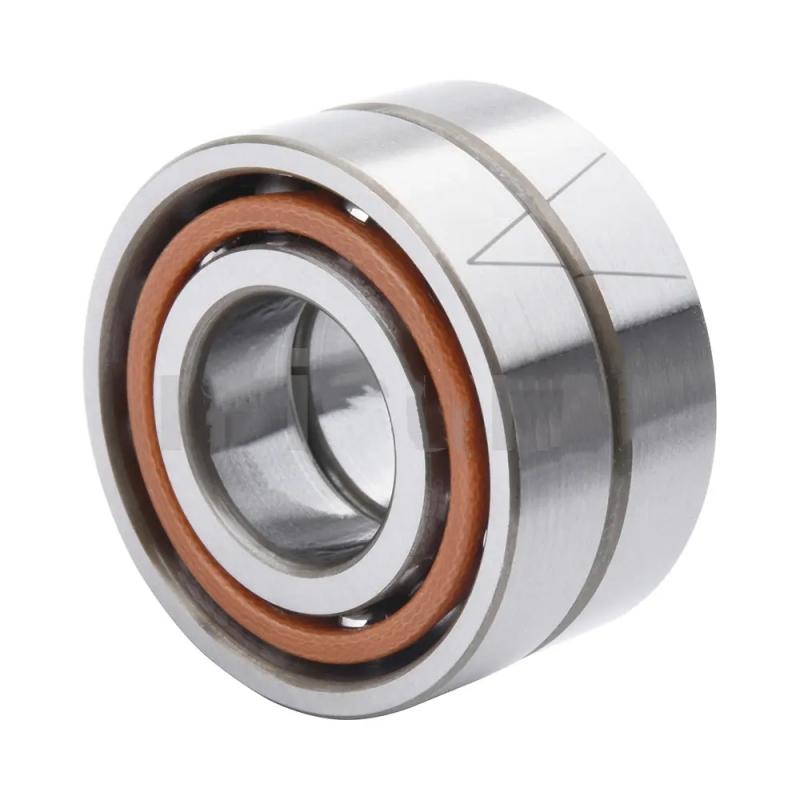
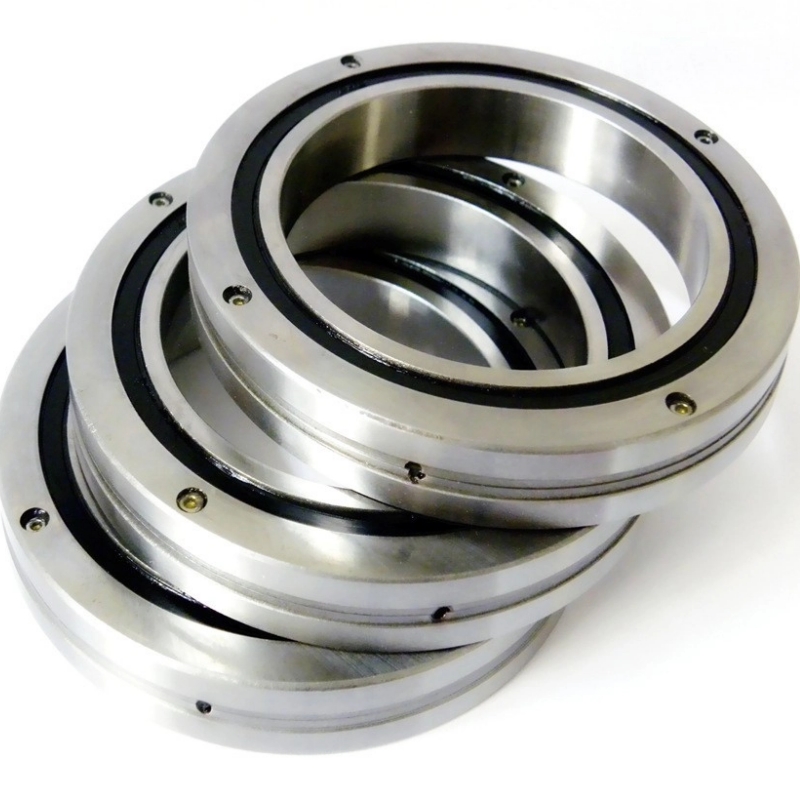
Pairing of angular contact ball bearings involves mounting two or more single-row bearings together to handle combined radial and axial loads that exceed a single bearing's capacity.Common arrangements include back-to-back (DB),face-to-face (DF),and tandem (DT),which offer varied rigidity,axial load capacity in one or both directions,and precise,predefined preloads.
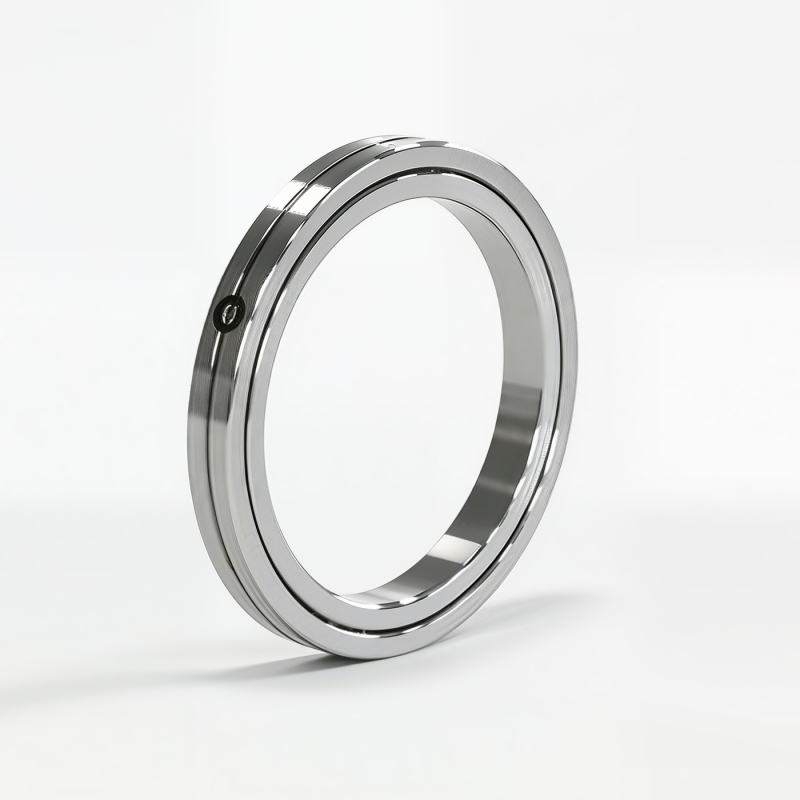
Three standardized pairing configurations are widely adopted in industry,each tailored to specific load characteristics and application requirements,with NewBee's thin-section bearings fully supporting these combinations:
Back-to-back pairing (DB configuration):Characterized by outer rings' wide edges facing outward (inner rings' narrow edges opposite each other),this configuration offers a large distance between load action points.It excels in rigidity and anti-overturning capacity,making it ideal for high-speed,high-precision equipment like CNC machine tool spindles and telescope mounts.NewBee's 40° contact angle thin-section bearings in DB pairing can withstand significant overturning moment while maintaining rotational stability.
Face-to-face pairing (DF configuration):With outer rings' narrow edges facing inward (inner rings' wide edges opposite each other),the load action points are close.This configuration provides good centering performance and is suitable for applications with radial load dominance,moderate axial loads,and potential shaft deflection,such as semiconductor wafer handling robots and medical CT gantry systems
Tandem pairing (DT configuration):Bearings are arranged in the same direction (outer rings' wide edges facing the same side),enabling combined axial load capacity in a single direction.It is typically used in scenarios requiring extremely high unidirectional axial loads,such as aircraft landing gear actuators and heavy-duty rotary tables.Multiple bearings can be added in tandem to enhance load capacity as needed.
Scientific pairing selection depends on comprehensive evaluation of five core factors,with NewBee's technical team providing professional guidance based on actual application scenarios:- Load characteristics:Bidirectional axial loads + high rigidity requirements → DB configuration; radial-dominant combined loads + shaft deflection risks → DF configuration; high unidirectional axial loads → DT configuration.
Precision requirements:Nanometer-level positioning (e.g.,semiconductor equipment) → DB pairing with preload optimization; general precision (e.g.,industrial robots) → DF configuration for easier installation.
Working speed:Ultra-high speeds (≥10,000 r/min,e.g.,high-speed spindles) → DB configuration with brass cages to reduce centrifugal force impact; medium-low speeds → DF/DT configurations as appropriate.
Installation space:Compact spaces (e.g.,thin-section bearing applications) → DF configuration with smaller axial footprint; sufficient space → DB configuration for better rigidity.- Environmental conditions:High-temperature/corrosive environments → Pairing of NewBee's 316 stainless steel or ceramic hybrid angular contact bearings,with material compatibility ensured across paired units.
Proper pairing implementation requires adherence to strict technical standards to avoid performance degradation,with NewBee's products meeting these core requirements:
Consistent bearing parameters:Paired bearings must have identical model,contact angle (15°/25°/40°),precision grade (ABEC-1/3/5),and radial clearance to ensure uniform load distribution.NewBee provides matched bearing sets with pre-tested parameter consistency.
Precise preload adjustment:Preload eliminates internal clearance to enhance rigidity-light preload for high-speed scenarios,medium preload for general precision,and heavy preload for high-rigidity requirements.NewBee offers customized preload settings for paired bearings.
Coaxiality control:Installation must ensure coaxiality of inner/outer rings (error ≤0.002mm) to prevent uneven loading.Specialized mounting tools are recommended for thin-section bearing pairings.
Lubrication matching:Unified lubrication solution-grease lubrication for general conditions (e.g.,lithium-based grease for 0-120℃) or oil lubrication for ultra-high speeds.NewBee's sealed paired bearings come pre-filled with matching lubricants.
Fit tolerance coordination:Shaft fit adopts h7 tolerance,housing fit H8 tolerance,avoiding excessive interference that may alter preload and clearance.
Improper pairing leads to severe performance issues,as observed in practical application cases:
Uneven load distribution:Mismatched bearing parameters cause individual bearings to bear excessive load,reducing service life by 50% or more and increasing failure risks.
Reduced rigidity and precision:Incorrect configuration (e.g.,DB for shaft deflection scenarios) leads to vibration,noise,and positioning errors-critical for precision equipment like semiconductor robots.
Overheating and lubrication failure:Excessive preload or misalignment increases friction,causing temperature spikes (exceeding 80℃) that degrade lubricants and trigger premature bearing seizure.
Structural damage:Tandem pairing for bidirectional loads results in one bearing bearing all axial force,leading to raceway wear,roller spalling,and potential equipment shutdowns.NewBeetrans's onsite technical support helps avoid such issues through proper pairing guidance.
Maintenance of paired bearings differs from single bearings,requiring targeted measures to preserve pairing performance:
Unified maintenance cycle:Paired bearings must be inspected,lubricated,or replaced simultaneously to avoid performance discrepancies between new and old units.
Preload recheck:Regularly verify preload (e.g.,annually for industrial equipment) using professional tools,with adjustments as needed due to wear or thermal deformation.
Cleanliness control:During disassembly/assembly,ensure no contaminants enter the paired system-critical for thin-section bearings with narrow clearances.
Damage replacement principle:Replace all paired bearings if one is damaged,as mixing new and old bearings disrupts load balance.NewBee offers cost-effective replacement kits for paired sets.
For technical specifications,customized pairing solutions,or onsite support for angular contact ball bearings:
Email:paul@newbeetrans.com
Website:www.newbeetrans.com
 WhatsApp
 sales@newbeetrans.com
 +8615090185276