
NewBee Machinery is a professional machinery parts manufacturer providing high quality precision bearings, high-quality non-standard transmission components, and intelligent CNC equipment and more.
NewBee Machinery is a professional machinery parts manufacturer providing high quality precision bearings, high-quality non-standard transmission components, and intelligent CNC equipment and more.
Sealed (2RS) bearings suffer around 40 % reduction in limiting speed,yet can multiply service-life by up to four-fold in polluted operating environments.Shielded (ZZ) bearings are capable of operating at full catalogue speed ratings.This article delivers quantified comparison data and practical selection matrix for engineers.
Contamination (14 %) and poor lubrication (36 %) together account for half of all premature bearing failures.The choice between low-cost metal shield and rubber contact seal determines whether a conveyor bearing survives six months or over two years in dusty working conditions.Still,sealed bearings are not always the optimal pick:superior contamination protection comes at the cost of roughly 40 % drop in maximum permissible rotational speed.
This engineering guide compares sealed and shielded bearings with hard performance figures:speed derating factors,temperature thresholds for different elastomer materials,friction loss values and application-oriented selection guidance.This article assumes you have already selected your bearing type (mostly deep-groove ball bearings),and you only need to decide on the protective enclosure configuration.
Key Takeaways-Shielded (ZZ) bearings run at full catalogue-listed limiting speed with near-zero additional friction;re-greasing is feasible through the 0.1-0.3 mm radial clearance gap,ideal for clean high-speed conditions.
Sealed (2RS) bearings bring approximately 40 % speed derating under all lubrication modes,but can extend service-life by 4× in heavily contaminated environments (SMB Bearings,2025).
Standard NBR seals degrade above 100 °C;select HNBR for 150 °C continuous service or FKM/Viton for environments up to 200 °C (SKF,2025).
From SKF failure statistics:lubrication failure 36 %,material fatigue 34 %,mounting error 16 %,contamination ingress 14 %.Contamination and lubrication-related failures represent 50 % of all premature bearing breakdowns,most of which can be mitigated by proper sealing solutions.
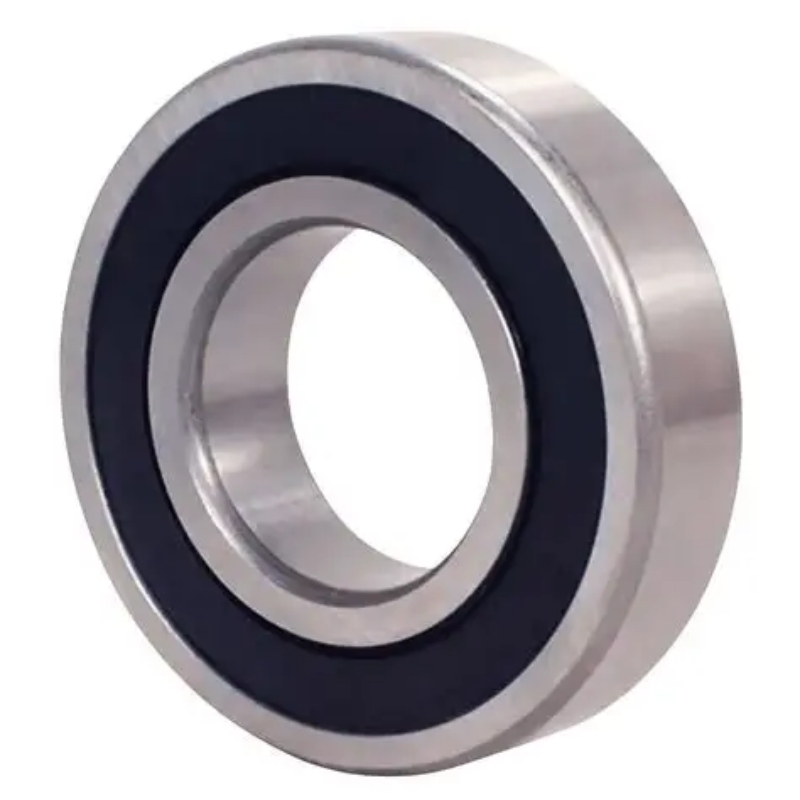
Shielded bearings (suffix ZZ/2Z) adopt pressed steel plates fitted into outer-ring grooves.A radial clearance of 0.1-0.3 mm remains between shield inner edge and inner-ring shoulder.Sealed bearings (suffix 2RS,2RSR,LLU,DDU depending on manufacturer) use steel-reinforced elastomer lips that make physical contact or maintain minimal clearance against inner-ring surface,forming a near-hermetic barrier.
This core structural distinction clearance-based non-contact versus lip-contact design-creates all performance trade-offs.

Note:Suffix conventions vary among brands.SKF uses 2RS1/2Z;NSK uses DDU/ZZ;NTN uses LLU/ZZ;FAG uses 2RSR/2Z.Despite different suffix codes,the physical working principle stays consistent:metal non-contact shield vs elastomer contact seal.
According to 2025 SMB Bearings technical data,contact-type sealed bearings reduce maximum permissible speed by ~40 %,while ZZ shielded bearings have zero speed penalty,since shields never touch rotating inner rings.
Speed limitation originates from frictional heat generated by sliding lip contact.The lip sliding surface speed should not exceed 8-10 m/s,otherwise accumulated heat will degrade seal material and internal grease (Machine Design).Taking 6205 bearing as example:seal contact diameter ≈32 mm.At 8-10 m/s lip speed,maximum rotational speed reaches 4800-6000 RPM.Beyond this threshold,seal service-life will dominate component failure.
Below uses catalogue grease-lubricated open-type 6205 limiting speed (14 000 RPM) as reference baseline:
If your application requires reaching full catalogue limiting speed,select shielded ZZ configuration.If operating speed stays well below maximum rating (e.g.conveyor running at 1 200 RPM),40 % speed derating has negligible practical impact,and sealed bearings become a viable option.
Per SKF 2025 seal-material specifications:Standard NBR continuous operating range:−40 °C ~ +100 °C,short-term peak up to 120 °C.For elevated-temperature environments:HNBR reaches 150 °C continuous;FKM/Viton can run continuously at 200 °C with short-term peak temperature of 230 °C.Metal ZZ shields themselves have no inherent temperature limit;maximum working temperature is only restricted by grease performance.
This difference is critical:in high-temperature setups,sealing lips often fail before rolling-contact fatigue occurs.NBR hardens,loses elasticity and cracks above 100 °C,turning your “sealed bearing” into an open-style unit filled with broken rubber debris.
 Practical specification guidance:
Working temperature below 80 °C:standard low-cost NBR seals work fine.
80 °C-130 °C range:specify HNBR seals.
Above 130 °C:choose either premium-priced FKM seals,or ZZ shielded bearings paired with high-temperature grease.Very often the ZZ + high-temp grease solution delivers better total cost-performance.
In contaminated environments,sealed bearings can achieve 4× or longer service-life compared with ZZ shielded variants.In dusty material-handling plants it is common to see ZZ-fitted conveyor bearings fail every six months,while 2RS-sealed units run for more than two years under identical system conditions.
Fine abrasive particles penetrate the 0.1-0.3 mm gap of ZZ shields,mix into internal grease and accelerate raceway wear and spalling.
SKF/STLE failure analysis (2019) classifies premature bearing failure root causes:lubrication degradation 36 %,material fatigue 34 %,mounting/handling damage 16 %,particle contamination 14 %.Contamination also accelerates grease ageing.Combined,contamination plus lubrication failure account for 50 % of all early-life breakdowns.
Contact-type 2RS seals solve two failure paths simultaneously:they block external contaminants and retain internal lubricant.ZZ shields can only partially stop solid particles and offer zero retention for grease loss.
Water ingress produces especially severe damage.Independent test data shows bearing fatigue-life drops by roughly 50 % once moisture content inside grease reaches 100-300 ppm.ZZ shields cannot block water vapour or liquid splashes;well-designed 2RS sealed bearings can resist such moisture ingress.
Important note:extended service-life is not automatically guaranteed for sealed bearings.Factory pre-filled grease inside sealed bearings normally occupies only 25-35 % of internal cavity volume.Once grease ages through high-temperature oxidation or long-time operation,sealed bearings cannot accept fresh grease without seal disassembly.In clean environments with scheduled re-lubrication maintenance,properly serviced ZZ shielded bearings may match or even exceed sealed-bearing service-life thanks to continuously refreshed grease.
The base friction coefficient for deep-groove ball bearings stands at μ = 0.0010-0.0015 (Koyo/JTEKT engineering data),measured for open bearings without shields or seals.Metal ZZ shields add negligible extra friction due to non-contact design.Contact rubber seals introduce additional friction coefficient μ = 0.001-0.003,varying with lip preload,rotating speed and lubricant status.
Real-world impact depends heavily on application scenarios:
Motors & spindles:Every watt of seal-caused friction converts into housing heat.For a 6205 bearing rotating at 10 000 RPM,seal friction may add 5-15 W parasitic loss.Higher temperature accelerates grease degradation and shortens bearing life.Such high-speed applications usually select ZZ shielded bearings or open-type bearings plus external labyrinth sealing structures.
Conveyor idlers:At 600 RPM with 20 mm bore size,extra friction loss from seals is below 1 W and can be ignored.Contamination protection is far more important than minor power loss.
Skate/recreational-grade equipment:Users pursue free-spin time,yet actual rolling resistance mainly originates from wheel deformation rather than bearing seal friction.Seal contribution is negligible.
Seal-induced power loss is physically real but numerically small.It only becomes a hard design constraint for high-speed precision thermal-management-critical equipment.
Shielded ZZ bearings support re-greasing without component disassembly.Grease gun injects fresh lubricant,and new grease flows through the radial gap between shield and inner-ring into bearing internal cavity.That makes ZZ a preferred choice for equipment with scheduled maintenance cycles:industrial motors,pumps,gearboxes with lubrication passages.
Sealed 2RS bearings are designed as “lubricated-for-life”.Grease is pre-filled at factory (25-35 % cavity fill ratio).The sealing lip eliminates radial clearance,so grease guns cannot inject fresh lubricant without manual seal removal.
You can manually pry out one seal lip,refill grease and reinstall the seal,yet three major risks appear:
Contamination enters the bearing cavity during seal-prying operation
Permanent seal-lip deformation leads to degraded sealing performance
Over-greasing raises internal operating temperature and accelerates grease ageing
For most industrial use-cases,direct bearing replacement upon end-of-life is more economical than risky manual re-greasing operations.The labour cost of careful seal removal and re-greasing often exceeds the price of a brand-new bearing.
When “lubricated-for-life” does not match real-world equipment duty-cycle:Standard lithium-based grease inside sealed bearings sustains roughly 20 000-30 000 operating hours under 70 °C working temperature.If equipment runs 8 000 hours per year,grease service-life equals only 2.5-3.7 years.When calculated L₁₀ fatigue life reaches 10 years,grease will fail far earlier than rolling elements.You must plan for periodic bearing replacement cycles.
The core rule:match bearing enclosure configuration to operating environment,do not blindly pick “better-sounding” solutions.Installing sealed bearings inside ultra-clean rooms wastes cost while accepting speed-reduction penalties.Fitting ZZ shielded bearings on outdoor dusty conveyors will trigger premature contamination-driven failure within months.
NewBee Transmission product note:NewBee Transmission supplies complete series of deep-groove ball bearings.Our standard 6205-2RS variant adopts NBR contact seals with continuous operating temperature up to 100 °C,C3 internal-clearance option available for applications where thermal expansion creates undesired preload.C3 clearance carries a cost premium of approximately 8-12 % versus standard CN clearance bearings.Custom HNBR and FKM seal options are supported for high-temperature,chemical-exposed and food-grade projects.Our engineering team provides seal-type consultation according to your actual working conditions.
Q:Can sealed bearings be re-greased?
A:Technically yes,but not recommended as routine maintenance work.You may pry off one seal lip,refill grease to 25-35 % cavity volume and reinstall the seal.Risks include contamination intrusion and permanent seal-lip damage.For most industrial scenarios,replacing the complete bearing delivers better total economy.
Q:Are ZZ shielded bearings water-proof?
A:No.The 0.1-0.3 mm radial gap between shield and inner-ring permits water and vapour penetration.Test data confirms free water inside grease can cut bearing fatigue-life by roughly half.For humid or splash-prone conditions,specify 2RS sealed bearings or deploy ZZ bearings within fully sealed bearing housings.
Q:Are sealed bearings always longer-lived than shielded bearings?
A:Only under contaminated environments;field cases show up to four-fold service-life improvement.Inside clean installations with scheduled reliable re-greasing cycles,shielded ZZ bearings can match or surpass sealed-bearing life thanks to continuously refreshed lubricant.Sealed bearings have a fixed finite grease supply with no way of field replenishment.
Q:What do suffix codes ZZ and 2RS actually mean?
A:ZZ/2Z means double-sided metal non-contact shields with radial clearance gaps.2RS/2RSR/DDU/LLU represent double-sided elastomer contact seals.Suffix naming conventions differ across SKF,NSK,NTN and FAG manufacturers,but physical operating principles remain consistent.Seal/shield suffix codes are independent of ABEC precision grades:a 6205-2RS bearing can be ABEC 1 or ABEC 5;sealing configuration will not change bearing dimensional tolerances.
Q:Should food-processing machinery use sealed or shielded bearings?
A:Sealed bearings are preferred,select FDA-21-CFR-177.2600 compliant food-grade FKM seals.Contact-type seals stop contaminants entering the bearing and also prevent internal grease leakage onto production goods.Using ZZ shielded bearings in food-processing environments carries risk of grease migration through clearance gaps contaminating product lines.
The core decision question between sealed and shielded bearings:Is your operating environment clean-enough to tolerate a 0.1-0.3 mm radial clearance gap?
If dust,moisture or process fluid splashing exists:select sealed 2RS bearings.Accept ~40 % speed derating and finite grease service-life in exchange for up to four-fold longer service-life in polluted conditions.
If working environment stays clean,high speed matters and maintenance re-greasing is planned:select ZZ shielded bearings.They run at full catalogue speed with negligible extra friction and support repeated re-lubrication.
For operating temperatures exceeding 100 °C:upgrade to FKM elastomer seals or adopt ZZ bearings together with high-performance specialty grease.Run cost comparison;shield plus high-temp-grease solutions often win economically.
Avoid over-specifying heavy-duty sealing for clean-environment applications,and never use insufficient shielding for harsh contaminated environments.Match enclosure selection to real-world site operating conditions.
For technical specifications,pricing,or custom bearing cage solutions:
Email:paul@newbeetrans.com
Website:www.newbeetrans.com

 WhatsApp
 sales@newbeetrans.com
 +8615090185276