
NewBee Machinery is a professional machinery parts manufacturer providing high quality precision bearings, high-quality non-standard transmission components, and intelligent CNC equipment and more.
NewBee Machinery is a professional machinery parts manufacturer providing high quality precision bearings, high-quality non-standard transmission components, and intelligent CNC equipment and more.
As a professional precision bearing manufacturer with 20 years of experience,NewBeetrans offers three mainstream bearing types-steel bearings,ceramic hybrid bearings,and all ceramic bearings-each with distinct radial load characteristics to adapt to diverse application requirements.This article will elaborate on the differences in radial load performance among the three types,combined with NewBee's product system and industrial practice.
Radial load performance refers to a bearing's capacity to withstand loads perpendicular to the shaft axis (radial direction) during operation,including load-bearing limit,wear resistance under radial force,and stability over long-term use.For NewBee's bearings,this performance is closely related to material properties,structural design,and manufacturing precision.It is a key consideration in scenarios such as robot joint rotation,semiconductor wafer handling,and medical equipment transmission,where insufficient radial load capacity may lead to bearing deformation,increased vibration,or even premature failure.
Steel bearings: Constructed with GCr15 bearing steel (or stainless steel) for both inner/outer rings and balls,featuring mature manufacturing processes.They are the most widely used type in general industrial scenarios,such as standard robot joints and general automation equipment.
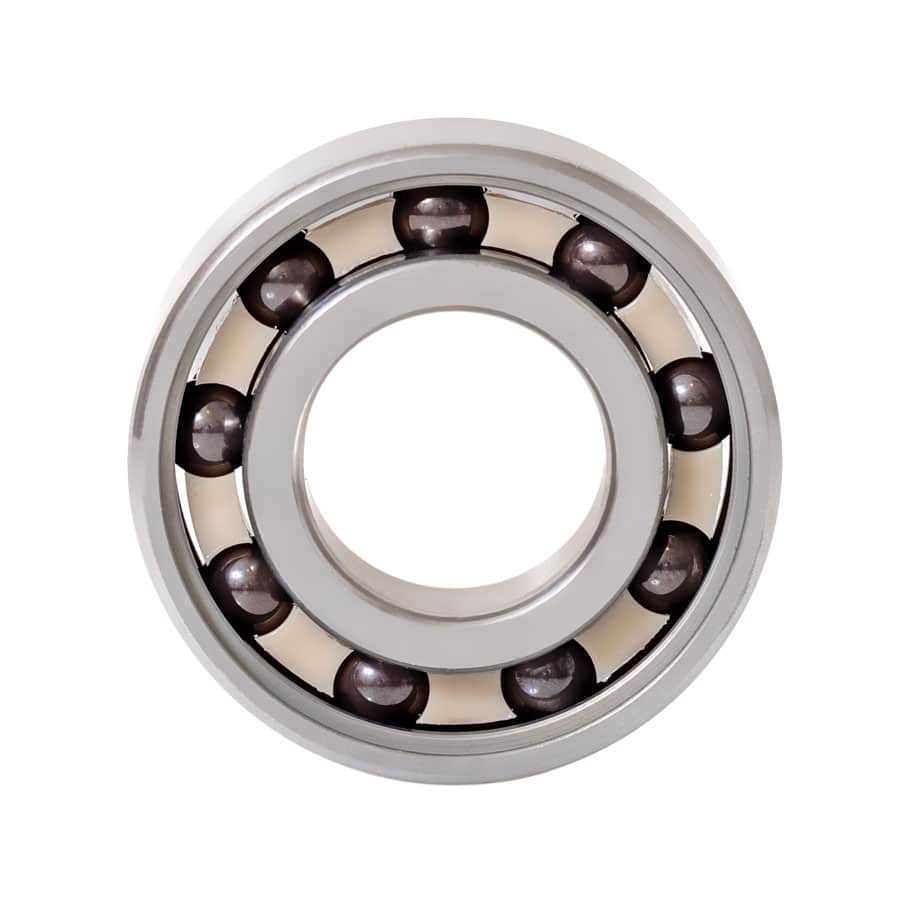
Ceramic hybrid bearings: Combine steel inner/outer rings with silicon nitride (Si₃N₄) ceramic balls.This hybrid design integrates the rigidity of steel rings and the wear resistance of ceramic balls,tailored for high-speed and high-precision scenarios.
All ceramic bearings: Made entirely of advanced ceramics (silicon nitride,zirconia,or alumina) for rings and balls.They excel in extreme environments,such as high temperature,corrosion,or vacuum,and are core products in NewBee's special environment bearing series.
The radial load capacity of the three bearings varies significantly due to material and structural differences:
Steel bearings: Offer balanced radial load performance,with a radial dynamic load rating ranging from 1.2kN to 50kN (for NewBee's standard series).GCr15 steel's excellent toughness and fatigue resistance enable stable load bearing in medium-load scenarios (e.g.,general industrial robots with radial loads of 5-20kN),making them cost-effective choices.
Ceramic hybrid bearings: Have 15%-30% higher radial load capacity than steel bearings of the same size.Silicon nitride ceramic balls have higher hardness (HV1500-1800 vs.HV800-1000 for steel) and lower density,reducing centrifugal force at high speeds and enhancing load-bearing stability.They are suitable for high-speed,medium-to-high load scenarios (e.g.,high-precision robot wrist joints with radial loads of 8-30kN).
All ceramic bearings: Their radial load capacity varies by material-silicon nitride all ceramic bearings have similar load capacity to steel bearings (1.1kN-45kN),while zirconia/alumina types are slightly lower.However,their advantage lies in maintaining stable radial load performance in extreme conditions (e.g.,200-800℃ high temperature or corrosive environments),where steel bearings may fail due to material degradation.
Several key factors influence the radial load performance of the three bearings:
Material hardness and strength: Ceramic materials (especially silicon nitride) have higher hardness than steel,improving wear resistance under radial loads but with lower toughness.
Structural design: NewBee's steel bearings adopt optimized raceway curvature,while ceramic hybrid bearings use precision-matched steel rings and ceramic balls to reduce contact stress.
Lubrication conditions: Steel bearings rely on conventional lubricants,while ceramic bearings (especially all ceramic types) require high-temperature resistant lubricants to maximize radial load performance.
Manufacturing precision: All three types meet ISO P5/P4 precision standards,but ceramic bearings' stricter dimensional control minimizes radial runout under load.
The performance differences determine their application boundaries in NewBee's target markets:
Steel bearings: Ideal for general industrial robots,AGVs,and conventional automation equipment with medium radial loads and standard operating conditions,balancing performance and cost.
Ceramic hybrid bearings: Preferred for high-speed precision equipment such as semiconductor wafer handling robots,collaborative robot joints,and medical imaging equipment,where high radial load capacity and low friction are required.
All ceramic bearings: Suitable for extreme environment applications like aerospace robots,high-temperature industrial furnaces,and corrosive chemical equipment,maintaining reliable radial load performance where steel bearings cannot adapt.
NewBee recommends a systematic selection process based on radial load needs:
Determine the radial load magnitude: For loads <8kN (light load) → steel bearings; 8-30kN (medium-high load) → ceramic hybrid bearings; extreme environment with load <25kN → all ceramic bearings.
Consider operating conditions: High speed (≥3000rpm) + medium load → ceramic hybrid bearings; high temperature/corrosion → all ceramic bearings; general conditions → steel bearings.
Match with equipment precision: High-precision positioning (nanometer level) → ceramic hybrid/all ceramic bearings; general precision → steel bearings.
All ceramic bearings have higher radial load capacity than steel bearings.In fact,their load capacity is similar or lower under normal conditions-their advantage lies in extreme environment adaptability.
Ceramic hybrid bearings are overkill for medium-load scenarios.They offer longer service life than steel bearings in high-speed medium-load applications,reducing maintenance costs.
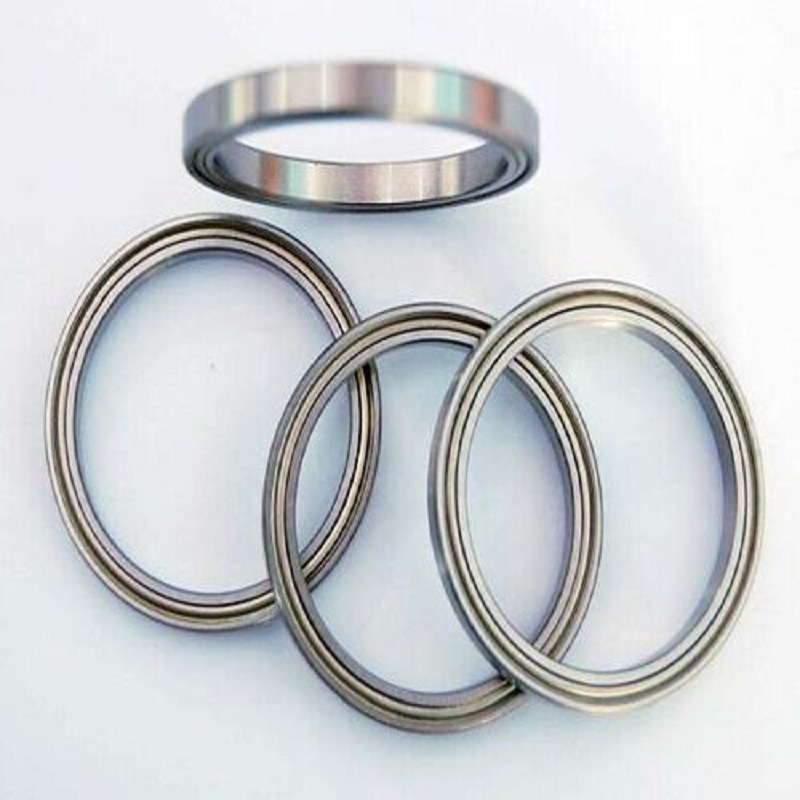
Steel bearings cannot handle high radial loads.NewBee's large-size steel bearings (e.g.,thin-section steel bearings for heavy-duty robots) can withstand radial loads up to 50kN,meeting heavy-duty needs.NewBeetrans tailors bearing solutions based on customers' radial load requirements and application environments,leveraging advanced materials and precision manufacturing to ensure optimal performance.Whether for standard or extreme conditions,the three bearing types provide reliable radial load support for intelligent manufacturing.
For technical specifications,pricing,or custom engineering solutions:
Email:paul@newbeetrans.com
Website:www.newbeetrans.com

 WhatsApp
 sales@newbeetrans.com
 +8615090185276