
NewBee Machinery is a professional machinery parts manufacturer providing high quality precision bearings, high-quality non-standard transmission components, and intelligent CNC equipment and more.
NewBee Machinery is a professional machinery parts manufacturer providing high quality precision bearings, high-quality non-standard transmission components, and intelligent CNC equipment and more.
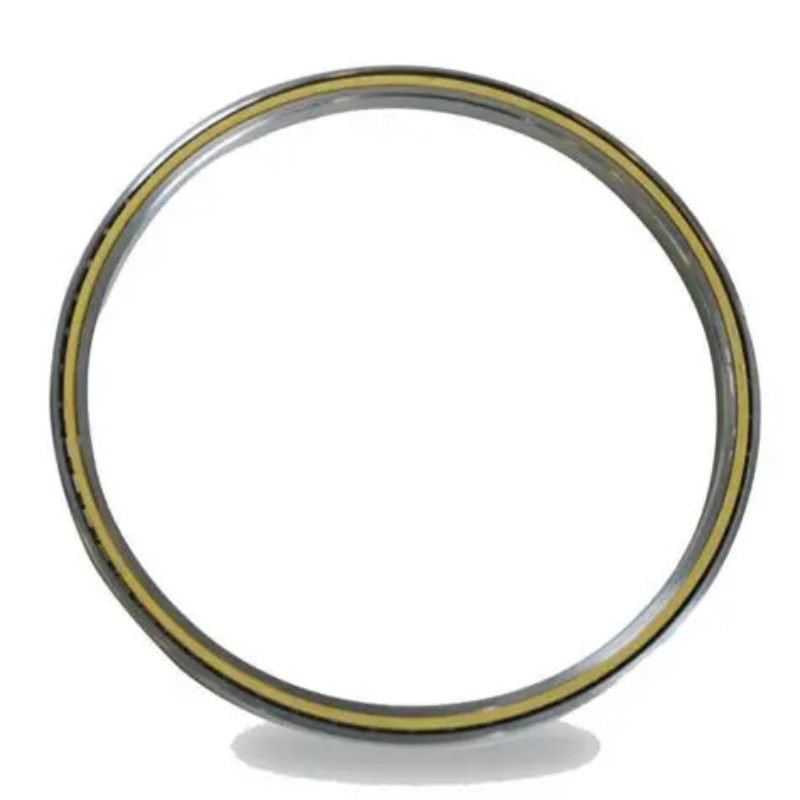
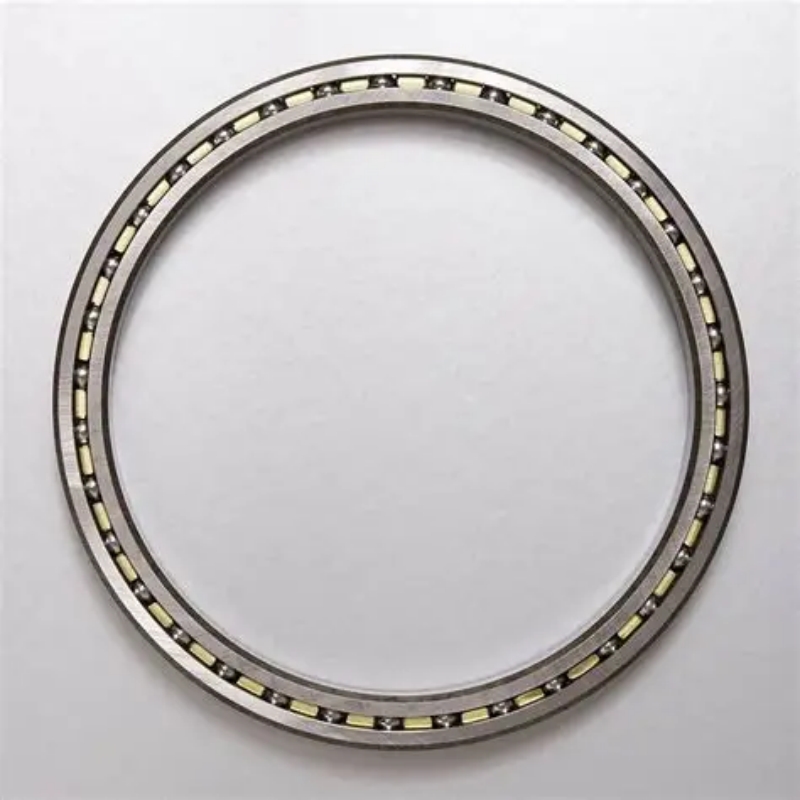
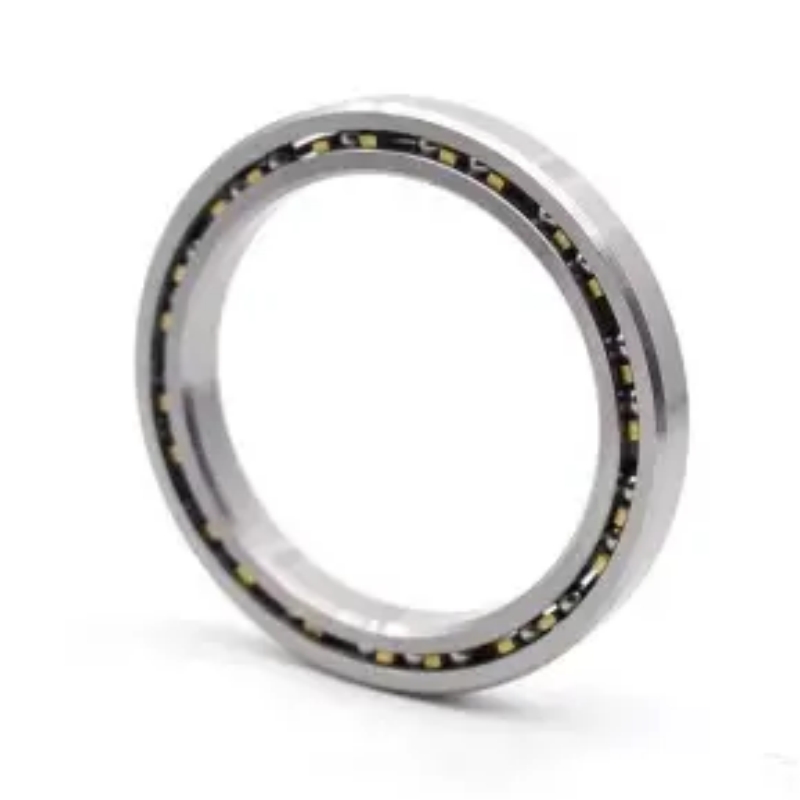
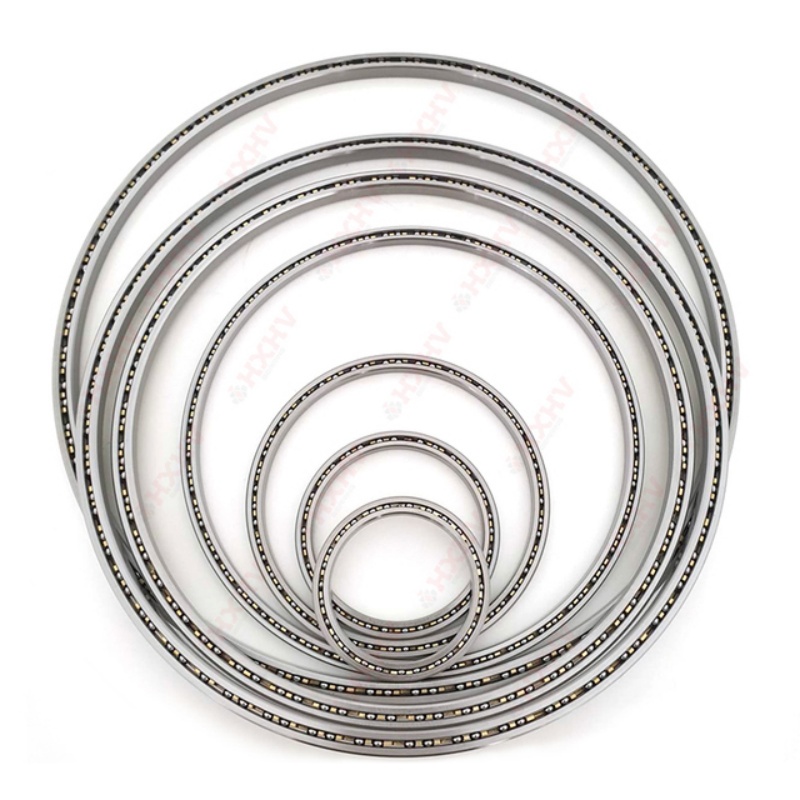
Type-A thin-section angular contact ball bearings are ultra-slim constant cross-section rotary components with inclined raceways forming fixed contact angles (15°,25°,40° customizable).They are specially engineered to bear combined radial and unidirectional axial loads simultaneously,perfect for compact,lightweight,high-precision limited-space equipment.
Core Technical Specifications
Contact Angle Options:15°,25°,40° for different thrust load demands.Size Range:Inner diameter 25.4-508mm,constant cross-section 10×10-15×15mm.Materials:Rings & rolling elements (52100 bearing steel,440C/316 stainless steel,ceramic hybrid);Cages (nylon,brass,stainless steel).
Precision Grades:ABEC-1/3/5 (P0,P6,P5) aerospace ultra-precision standards.Sealing & Lubrication:Open,shielded,fully sealed structures;standard anti-oxidation grease,vacuum low-outgassing solid lubricants for cleanroom & medical environments.Operating Temperature:-40℃ ~ 120℃,customized extreme low-temperature lubricant for special working conditions.
Lead Time:Standard models ship within 5–15 working days;customized preloaded bearings with special coatings require negotiated delivery schedules.
Humanoid and bionic robots are anthropomorphic robotic equipment that simulates human body structure,joint movement and limb coordination,covering service companion humanoid robots,industrial humanoid handling robots,medical rehabilitation exoskeleton robots,bionic dexterous hand robots,four-legged bionic quadruped robots and laboratory bionic research platforms.All joints of humanoid and bionic robots,including neck,shoulder,elbow,wrist,waist,hip,knee and miniature finger joints,need built-in precision rotary bearings matched with servo motors and harmonic reducers.The internal space of each joint is extremely narrow,and hollow channels must be reserved for power lines,signal cables and air pipelines.During walking,grasping and frequent reciprocating swing,the rotary joints bear alternating radial self-weight,unidirectional axial thrust and impact overturning loads.Ordinary standard bearings are bulky and heavy,and large internal clearance will cause limb jitter,poor repeated grasping accuracy and unstable balance control.Therefore,ultra-light,zero-backlash thin section angular contact ball bearings become the core rotary support of all bionic joint modules.
Constant Cross-Section Design
Space & Weight Saving:Unlike standard ISO series bearings-where cross-sectional height increases as bore size increases-thin section bearings maintain a fixed,extremely narrow cross-section regardless of the shaft diameter.
Compact Footprint:This constant geometry drastically reduces envelope dimensions,overall assembly weight,and rotational inertia without sacrificing shaft diameter size,reserving large hollow inner holes for robot internal cable routing.
High Axial (Thrust) Load Handling in One Direction
Contact Angle Geometry:The inner and outer ring raceways are displaced relative to each other along the bearing axis,typically creating a 15°,25° or 40° contact angle.
Combined Loads:This geometry enables the bearing to support high thrust loads in one direction,alongside concurrent radial loads.
Duplex Configurations:To support bidirectional thrust loads or increase joint stiffness,these bearings are mounted back-to-back (DB) or face-to-face (DF) in pairs inside robot joint reducers.
Precision & High Rigidity
Preload Capability:Thin section angular contact bearings can be ground for light,medium or heavy preloading.Preloading removes internal clearance and mechanical backlash,eliminating limb jitter during low-speed bionic motion.
Smooth Rotational Accuracy:Ultra-precision superfinishing ensures minimal rotational runout,realizing micron-level repeated positioning for grabbing and walking actions.
Low Friction & Low Torque
Small Rolling Elements:Miniature steel balls cut centrifugal force and rolling resistance greatly.
High-Speed Efficiency:Low friction generates little heat during frequent reciprocating swing,avoiding grease aging inside sealed joint cabins and reducing servo motor power consumption.
Humanoid & Bionic Robot Core Joints
Miniature finger joint bearings,multi-axis wrist modular bearings,elbow swing supports,shoulder rotary joints,waist rotation bearing sets,hip & knee pivot bearings,neck sensor rotary bases,bionic dexterous hand rotary shafts,exoskeleton limb joint components.
General Industrial Collaborative Robots
Six-axis cobot shoulder,elbow and wrist joint bearings,desktop miniature handling robot rotary indexing tables,flexible feeding equipment rotating positioning units.
Aerospace & Precision Optics
Airborne optoelectronic pod gimbals,small drone PTZ camera rotary supports,satellite antenna pointing mechanisms.
Semiconductor & Cleanroom Automation Wafer transfer robot arms,EFEM rotary modules
Semiconductor & Cleanroom Automation
Wafer transfer robot arms,EFEM rotary modules
Wafer transfer robot arms,EFEM rotary modules,vacuum low-particle precision turntables.
Medical Equipment
Surgical robotic wrist bearings,CT small rotating components,rehabilitation exoskeleton rotary joints,pharmaceutical sorting manipulators.
Ultra-Light Joint Design Reduces Inertia & Energy Consumption:Every gram of extra weight on robot limbs will increase servo load,shorten battery life and slow down dynamic response speed.Thin section angular contact ball bearings reduce component weight by over 40% compared to same-bore standard bearings.Lighter rotary parts lower overall limb inertia,making the robot’s walking,arm stretching and grabbing movements more sensitive and flexible,while effectively extending the continuous working time of battery-powered humanoid robots.
Fixed Thin Wall Realizes Hollow Cable Layout for Joints:Humanoid robot joints need to run numerous power and signal lines through the center hollow hole to avoid external wire winding during rotation.Conventional thick bearings occupy too much radial space and cannot reserve central wiring channels.The constant thin cross-section design retains a large inner diameter under small overall size,allowing all wiring to pass through the bearing center,simplifying joint structural design and eliminating cable abrasion risks caused by limb rotation.
Preloaded Zero Backlash Ensures Bionic Motion Precision:Humanoid robots need sub-millimeter repeated positioning accuracy for grabbing objects and stable standing balance.Ordinary bearings have internal play,which will lead to arm shaking and grasping deviation after multiple reciprocating movements.Preloaded thin angular contact ball bearings completely eliminate rotational clearance,restrain micro-vibration under walking impact and alternating grasping loads,guarantee stable and smooth bionic actions and reduce the defective rate of precision operation tasks.
Composite Load Bearing Simplifies Joint Modular Structure:A group of paired thin bearings can simultaneously bear the radial weight of robot arms,axial tension of reducers and overturning moment generated by grabbing heavy objects,replacing multiple sets of separate radial and thrust bearing combinations.It reduces the number of mechanical parts inside joints,shortens assembly time and lowers the manufacturing and after-sales maintenance cost of humanoid robots.
Diversified Lubrication & Sealing Adapts Multiple Scenarios:We provide food-grade clean grease,medical low-dust lubricant and fully dust-proof sealed bearing options.Different types adapt home service scenes,sterile medical workshops and factory industrial environments,avoiding frequent disassembly for oil replenishment and supporting long-term unattended automatic operation of bionic robots.
Excellent Anti-Fatigue Performance Extends Robot Service Life:The raceway surface is deep hardened to HRC55–62 with outstanding anti-vibration and anti-wear performance,capable of enduring millions of walking and grabbing cycles.It greatly reduces the frequency of bearing replacement and robot shutdown maintenance,improving the continuous operation efficiency of humanoid robots in factories and medical institutions.
Newbeetrans is a professional manufacturer specializing in customized thin section bearings for all types of humanoid robots,bionic quadruped robots and medical rehabilitation exoskeleton joint modules.
Humanoid Robot Customization Service:Supply low-inertia preloaded thin bearings,stainless steel dust-proof & cleanroom customized versions,medical low-pollution special lubrication models; robot prototype sample bearings can be delivered within 10–15 working days according to customer technical drawings.
Strict Precision Inspection:All inner rings,outer rings and steel balls adopt ultra-precision superfinishing process.Every finished bearing passes low-torque test,reciprocating swing fatigue test and micro-runout inspection to meet bionic robot micron-level precision requirements.
Stable Global Shipment:Large stock of standard Type A thin bearings supports fast delivery; complete air and sea cross-border logistics serve robot manufacturers and research institutions worldwide.
Authoritative Quality Certification:Products comply with ISO 9001 quality management system,SGS cleanroom and low-friction test reports can be provided on request.
Global Technical Support:Professional bearing engineering team provides load calculation,contact angle matching and duplex preload design for all humanoid bionic joint structures.
For technical specifications,pricing,or custom bearing solutions:
Email:paul@newbeetrans.com
Website:www.newbeetrans.com
 WhatsApp
 sales@newbeetrans.com
 +8615090185276