
NewBee Machinery is a professional machinery parts manufacturer providing high quality precision bearings, high-quality non-standard transmission components, and intelligent CNC equipment and more.
NewBee Machinery is a professional machinery parts manufacturer providing high quality precision bearings, high-quality non-standard transmission components, and intelligent CNC equipment and more.
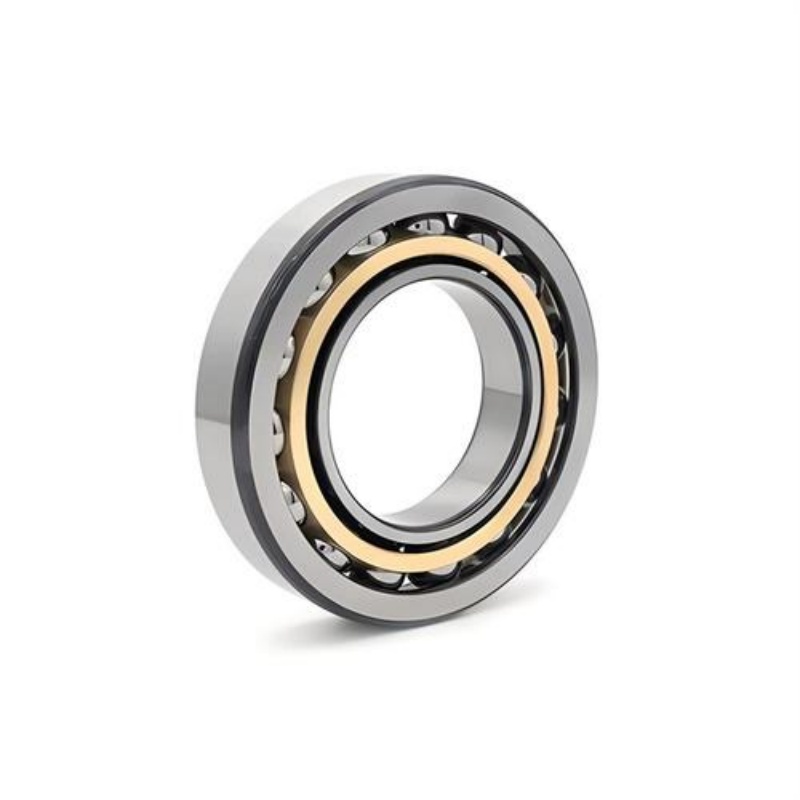
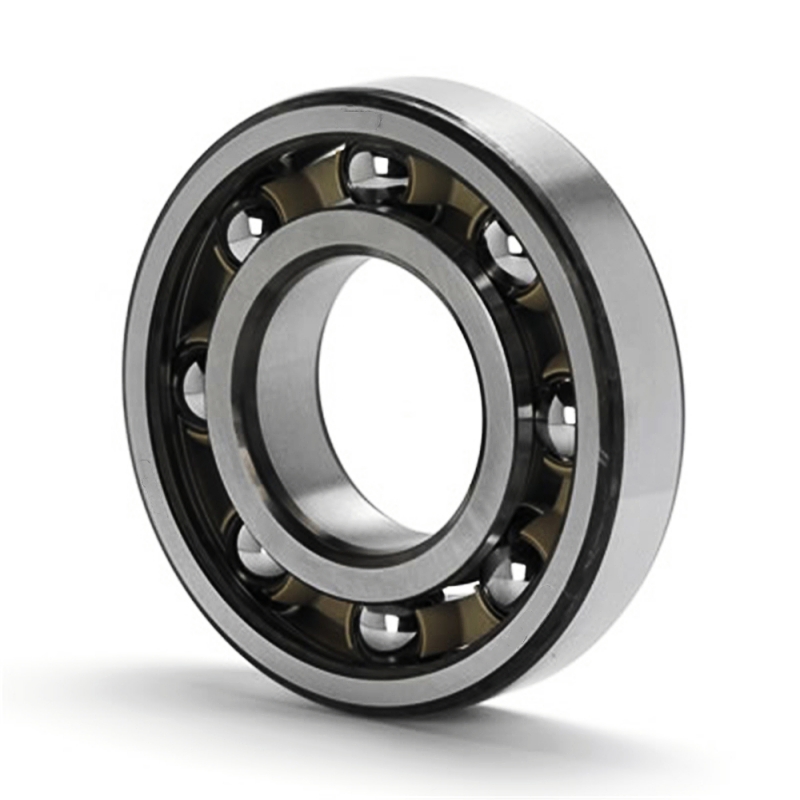
Angular contact ball bearings look similar to standard ball bearings,yet they can handle substantial axial thrust while carrying radial loads.This capability enables CNC machine tool spindles to maintain micron-level rotational accuracy at 15 000 rpm,and automotive wheel hubs to withstand side loads during sharp cornering.The core parameter governing such performance is the contact angle.One critical design note:single-row angular contact bearings can only accept thrust loads from one single direction,so they are nearly always supplied and installed in matched pairs.
Why pair-mount? A single-row unit cannot locate the shaft against reverse-direction axial force.This guide covers contact-angle trade-offs,single-row/double-row distinctions,DB/DF/DT duplex setups,preload tuning,and side-by-side comparisons versus other bearing types.
Loads travel along a line forming a defined contact angle (typical:15°,25°,30°,40°).Single-row bearings support combined radial-axial loads but only for one thrust direction.
Due to one-way thrust limitation,practical installations adopt duplex arrangements:DB (back-to-back,high moment stiffness),DF (face-to-back,higher misalignment tolerance),DT (tandem for large unidirectional thrust).
Larger contact angle = higher axial-load capacity but reduced radial capacity and limiting speed.Smaller angles favour radial performance and high-speed operation.
Preload is a balancing factor among stiffness,running accuracy,heat generation and fatigue life,critical for spindle design.
Contact-angle suffix codes (A/B/C/E) vary between manufacturers:always cross-reference original manufacturer datasheets before ordering.
Inner-ring and outer-ring raceways are offset relative to one another.Load is transmitted along an inclined contact line,creating both radial and axial force components.A single bearing can carry combined radial-axial loads,yet axial force can only act from one side.
Compared with deep-groove ball bearings,one shoulder on each ring is raised while the opposite shoulder is relieved.The high shoulder bears thrust in the designed direction:the relieved shoulder offers minimal support for reverse thrust,hence the requirement for paired installation.
Two product forms are available:loose single-row bearings for customer-configured duplex mounting,and factory-assembled double-row angular contact bearings.
Contact Angle Breakdown:15°,25°,30°,40°
Contact angle defines the balance between radial-load capacity,axial-load capacity and maximum permissible speed.Larger angles boost thrust capacity at the cost of reduced radial rating and lower limiting speed.Standard nominal angles are 15°,25°,30°,40°.
15°:Higher radial-load rating,excellent high-speed performance,moderate thrust capacity.Widely adopted for high-speed machine-tool spindles.
25°:Balanced radial-axial performance,general-purpose precision spindle solution.
30°:Improved axial-load capacity for mixed-load operating conditions.
40°:Maximised thrust-load rating,lower radial capacity and reduced speed limit:preferred for screw-drive supports and wheel-hub assemblies.
Important note:suffix letters for contact-angle designation are not universal across brands.For example,“B” means 40° within NTN notation,“C” represents 15°,while SKF/NSK apply different code rules.Always verify from manufacturer catalogues.
Single-Row versus Double-Row Angular Contact Bearings
Single-row angular contact ball bearing Can only withstand thrust from one direction,requiring duplex pairing for bidirectional axial positioning.Engineers select DB/DF/DT combinations according to stiffness,moment-load and misalignment requirements.Users can fine-tune preload by shims,spacers or matched ground faces.Higher assembly skill is demanded,offering maximum design flexibility for precision spindles.
Double-row angular contact ball bearing Two opposed ball rows integrated inside one outer ring.A single double-row unit supports bidirectional thrust plus overturning-moment loads without needing a second mating bearing.Preload is factory preset.Compact footprint,typical for automotive wheel hubs,gearbox output shafts and pump applications.Choose double-row if compact layout is priority and no on-site pre-load adjustment is required.Select single-row sets when custom duplex arrangement and adjustable preload for spindles are needed.
DB,DF & DT:Duplex Arrangement Explained
Three standard duplex configurations for matched single-row angular-contact bearings.Wrong arrangement may produce excessive vibration under moment load or cause shaft binding due to over-constraint.
DB (Back-to-Back,“O” arrangement)
Outer-ring backs face each other.Load lines diverge outward.Generates wide effective load centre distance,high overturning-moment stiffness,yet small permissible misalignment.The primary choice for machine-tool spindles resisting bending moments from overhanging cutting tools.Handles bidirectional axial loads.
DF (Face-to-Face,“X” arrangement)
Outer-ring front faces face each other.Load lines converge inward.Narrower load-centre spacing and lower moment stiffness,but larger tolerance for shaft-housing misalignment.Suitable for installations with poor concentricity,also accepts bidirectional thrust.
DT (Tandem arrangement)
Two identical bearings oriented identically.They share large unidirectional axial thrust,doubling single-set thrust capacity.Cannot resist reverse-direction axial force:a separate locating bearing must be fitted for opposite-direction positioning.Used for vertical pumps and heavy screw supports.

Preload is intentional initial axial force applied across duplex bearing sets to eliminate internal clearance,improve rigidity and enhance rotational accuracy.Trade-offs:higher preload increases friction heat and shortens fatigue service life.Insufficient preload reduces spindle stiffness:excessive preload creates thermal overheating and premature failure.
Three common preload implementation approaches:
Universal matched bearings:End-faces precision-ground in factory.Clamping matched faces delivers repeatable defined preload.
Shim/spacer adjustment:Install custom-thickness shims or spacers between rings to set target preload value.
Spring preloading:Constant light preload maintained automatically even with thermal shaft elongation.
Preload grades:Light/Medium/Heavy.Higher pre-load → better stiffness & accuracy,higher heat generation,shorter fatigue life.
Practical workshop experience:Top failure causes for returned duplex bearing assemblies:mixing unmatched bearing sets and reversed installation orientation.Match-mark (“V” stamp) on duplex bearings defines maximum radial-run-out position:align marks correctly during mounting.DB and DF configurations cannot be swapped.Excessive shaft interference fit adds unintended extra preload and accelerates thermal failure.
Preload interacts directly with internal radial clearance defined by ISO 5753-1:C2,CN (normal),C3,C4.For duplex angular-contact sets,mounting preload and residual clearance represent two sides of one adjustment process.Always perform L₁₀ life calculation under real-world working loads before specifying preload magnitude.
Angular-Contact vs Deep-Groove vs Tapered-Roller Bearings
Select bearing type based on load composition and operating speed:
Deep-groove ball bearing:Cost-effective,single unit accepts moderate bidirectional axial plus radial loads.Best for radial-dominant conditions with small additional thrust.Not suitable for high spindle-level rigidity requirements.
Angular-contact ball bearing:Excellent for high-speed,high-precision combined-load scenarios.Requires pairing for bidirectional thrust.
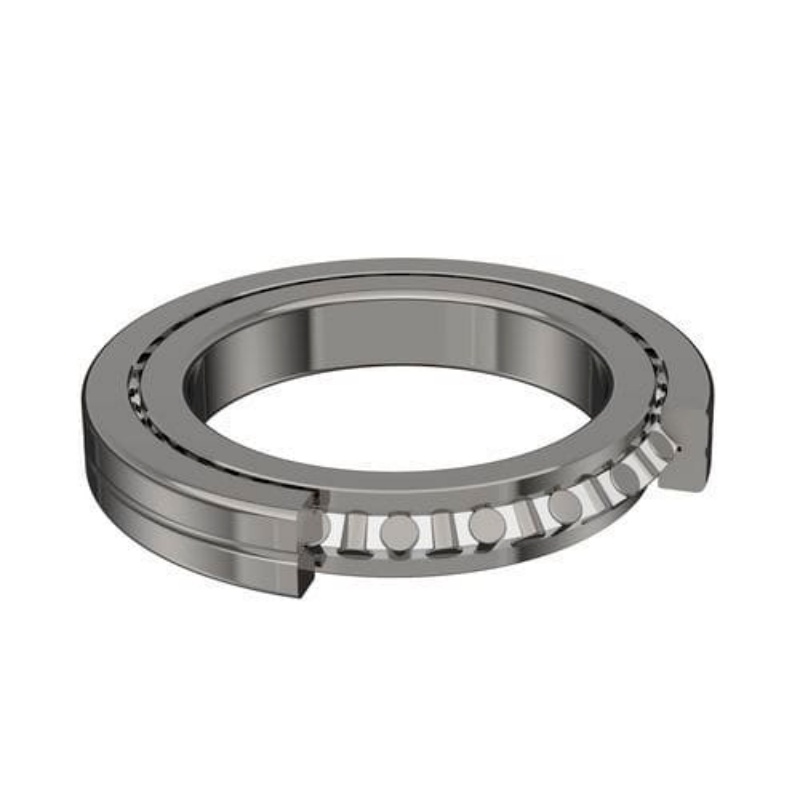
Tapered-roller bearing:Line-contact rollers deliver heavy combined-load capacity at medium-low rotational speeds,higher friction and heat generation compared with ball-type.
Decision logic:
Radial-dominant plus minor axial load → Deep-groove ball bearing
Combined load requiring high-speed & high precision → Paired angular-contact ball bearing (DB/DF/DT)
Heavy combined-load,medium-low rotating speed → Tapered-roller bearing
Pure heavy axial-load condition → Select thrust-series bearing.
Installation Guidance & Part-Number Decoding
Three core installation rules for matched angular-contact bearings:maintain correct orientation for duplex sets:control interference fit to avoid unintended extra preload:never intermix unmatched bearing groups.
Installation steps summary:
Confirm DB/DF arrangement and align orientation marks.
Clean shaft and housing seats,remove burrs and surface defects.
Choose interference fit that secures rings without introducing excess preload:avoid over-tight inner-ring fit.
Apply even mounting pressure only onto the fitted ring:never transmit assembly force through balls and raceways.
Apply correct-grade grease,lock shaft nuts to specified torque value.
Verify key dimensions against ISO 15 before assembly.
Part-number example:7208 B E P5 UA
7:Angular-contact bearing family
2:Dimension series
08:Bore code:08 × 5 = 40 mm bore
B:Contact-angle code (manufacturer-dependent,e.g.40° for NTN)
E:Reinforced internal geometry
P5:ISO 492 precision grade
UA:Universal match,light preload after duplex mounting
Precision grades per ISO 492:P0 (Normal),P6,P5,P4,P2,accuracy improves sequentially.High-speed spindles generally specify P4/P2 grade.
Major applicable standards:
ISO 15:Boundary dimensions
ISO 281:Basic dynamic load rating & rating-life formula:L₁₀= (C/P)ᵖ (p = 3 for ball bearings)
ISO 76:Basic static load rating
ISO 492:Geometric tolerance specifications
ISO 5753-1:Internal radial-clearance groups
Note:When calculating service life for duplex angular-contact sets,induced axial force created by radial load must be included in equivalent dynamic-load P calculation.
Typical applications of angular-contact ball bearings
High-speed machine-tool spindles,high-speed centrifugal pumps,gearboxes,automotive wheel-hubs,EV drive motors,robot joints,aerospace auxiliary mechanisms.They deliver among the highest limiting speeds within ball-bearing categories.Actual nDm limiting values must be obtained from manufacturer catalogues,depending on bearing series,duplex arrangement,pre-load grade and lubrication method.
NewBee Transmission manufactures full-range single-row and double-row angular-contact ball bearings covering bore 10 mm-800 mm,precision grades P0/P6/P5/P4,contact-angle options 15°/25°/30°/40°.Materials include GCr15 chrome bearing steel and 440C stainless steel.Open,shielded and sealed variants are in stock:customised duplex sets,special cages and pre-load specifications are supported for spindle,robotics and aerospace projects.Our engineering team provides load-life calculation,duplex-arrangement consultation and installation guidance for customer projects.
Q:Where are angular-contact ball bearings used?
A:They handle combined radial-axial loads under high-speed or high-precision operating conditions.Representative cases:machine-tool spindles,high-speed pumps,gearboxes,wheel-hubs,robot joints and aerospace components.Single-row types almost always run in duplex pairs,with contact-angle range approximately 10°-45°.
Q:What do 15°,25°,30°,40° contact-angle values mean?
A:Contact-angle allocates the ratio between radial-load capacity and axial-load capacity.Small angles (15°) optimise high-speed radial-load performance:large angles (40°) prioritise thrust-load capability.Suffix letters (A/B/C/E) differ by brand,always refer to original manufacturer datasheets.
Q:What are the differences between DB,DF and DT duplex arrangements?
A:DB (back-to-back “O”) delivers high moment stiffness with narrow misalignment tolerance-standard spindle solution.DF (face-to-face “X”) accepts larger misalignment at lower tilting stiffness.DT (tandem) orients two bearings identically to share heavy one-way thrust:an extra locating bearing must counter reverse thrust.
Q:Why install angular-contact bearings in pairs?
A:Single-row angular-contact bearings can only sustain thrust from one direction.Opposite-direction paired mounting enables bidirectional thrust resistance and allows controlled pre-load setup.Products are supplied as universal-match sets,factory-ground duplex units or integrated double-row bearings.
Q:Angular-contact ball bearing versus tapered-roller bearing:which is better?
A:No universal winner:select by working conditions.Angular-contact ball bearings excel for high-speed,low-friction,high-precision spindle applications.Tapered-roller bearings achieve heavy combined-load capacity at moderate-low rotational speeds.
Contact angle is the core design variable of angular-contact ball bearings,governing thrust capacity,permissible rotating speed and shaft-system stiffness.
Contact-angle selection trades radial performance for axial-thrust capacity:choose 15° for high-speed radial-dominant work:choose larger angles for heavy thrust conditions.
Single-row units require duplex mounting:DB/DF/DT each have distinct stiffness and misalignment behaviour.
Pre-load improves spindle stiffness and precision at cost of higher heat and shorter service-life:avoid excessive pre-load.
Compare deep-groove,angular-contact and tapered-roller solutions according to real-world load-speed conditions instead of habitual selection.
Always verify contact-angle suffix codes against manufacturer catalogues,as letter codes are not standardised across brands.
If you require support for duplex-arrangement definition,pre-load calculation or bearing selection for spindles and high-speed rotary assemblies,please contact the NewBee Transmission engineering team for matching contact-angle,duplex configuration and pre-load recommendations.
For technical specifications,pricing,or custom bearing cage solutions:
Email:paul@newbeetrans.com
Website:www.newbeetrans.com

 WhatsApp
 sales@newbeetrans.com
 +8615090185276