
NewBee Machinery is a professional machinery parts manufacturer providing high quality precision bearings, high-quality non-standard transmission components, and intelligent CNC equipment and more.
NewBee Machinery is a professional machinery parts manufacturer providing high quality precision bearings, high-quality non-standard transmission components, and intelligent CNC equipment and more.
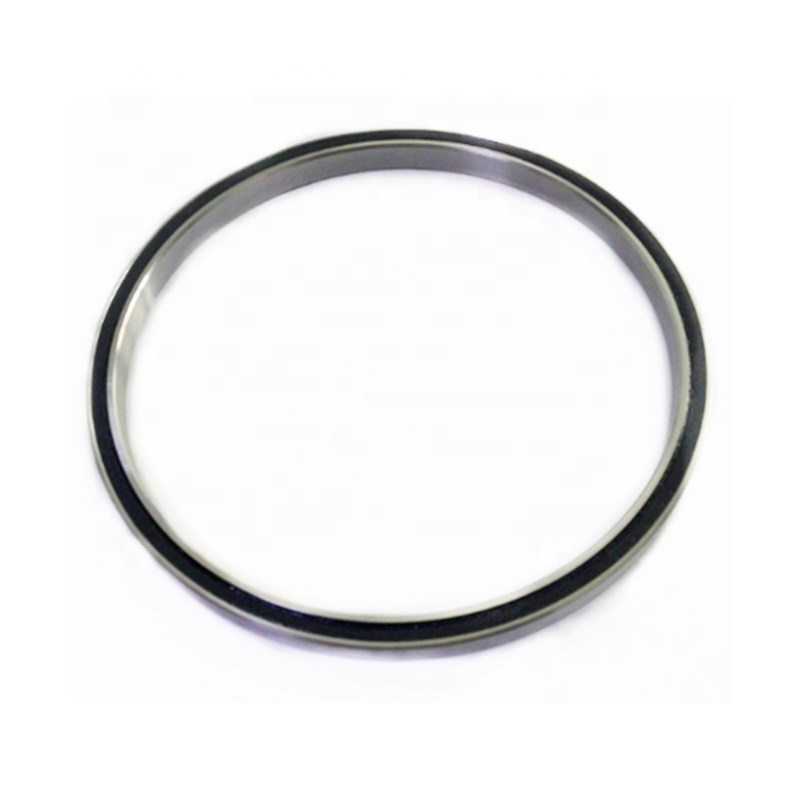
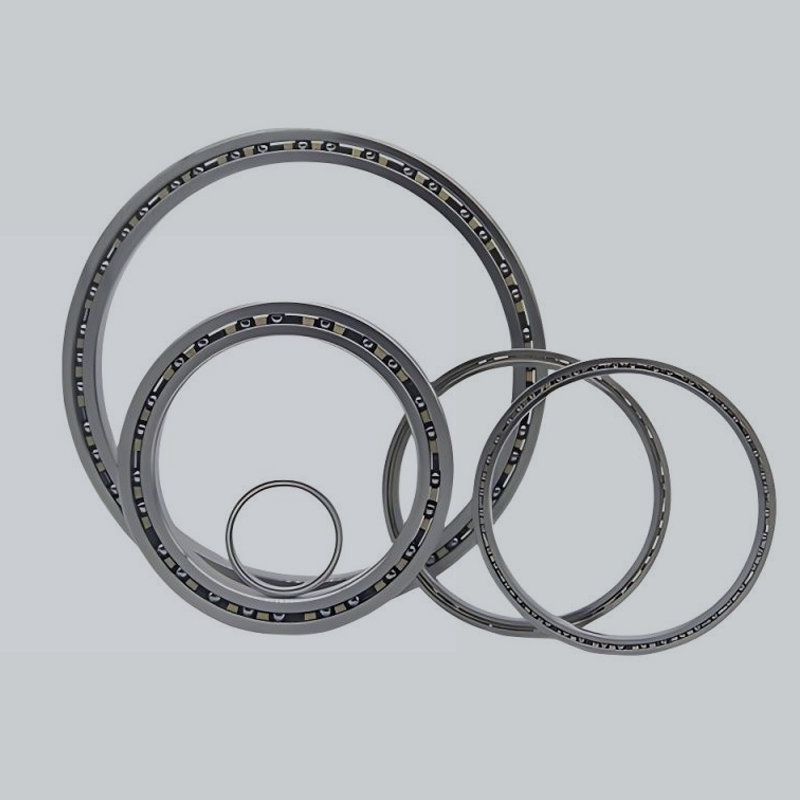
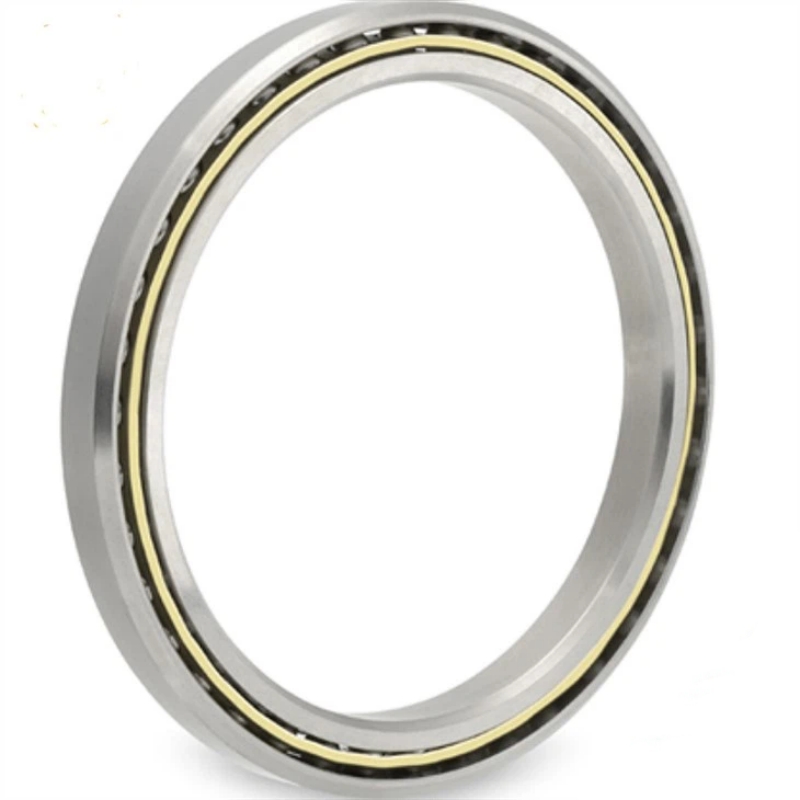
Thin-section bearings feature an extremely slim radial cross-section relative to their bore size.Many designers turn to thin-section bearings when housing space cannot be enlarged,and upsizing the shaft would compromise mechanical strength.Instead of reducing the bore diameter,engineers retain the original shaft size and adopt thin-section geometry to cut overall envelope and component weight.
There exist two completely distinct bearing families sold under the “thin-section” name,and they are not interchangeable.Mixing them up will result in parts that fail to fit the designed assembly.This article clarifies their differences,introduces Type-C/Type-A/Type-X raceway geometry,explains load-rating inconsistency across suppliers,and lays out critical installation rules that define real-world service life.
Practically,a bearing qualifies as thin-section when its radial cross-section is less than one-quarter of the bore diameter and less than twice the ball diameter.This is a ratio-based definition instead of a fixed absolute dimension.
Conventional standard bearings grow thicker as bore size increases.Thin-section bearings break this rule:they deploy a larger number of smaller-sized balls running on an expanded pitch circle.The design trades partial load capacity and tighter mounting tolerances for dramatically reduced space occupation and lighter weight.
Sample comparison for 50 mm bore:
| ||||
Formula for quick self-verification:(OD-Bore) ÷ 2 ÷ Bore.If the result is below 0.25,the bearing meets the thin-section ratio criterion.
Family 1:Metric ISO 68xx/69xx Series
These metric thin-size series follow ISO 15 dimensional standard,widely stocked and supplied by most bearing manufacturers including NewBee Transmission.
Their cross-section remains thin compared to standard bearings but still increases as bore grows.68xx and 69xx are “thin-size”,not constant-cross-section.
| |||
Family 2:Inch-Size Constant-Cross-Section Thin-Section Bearings
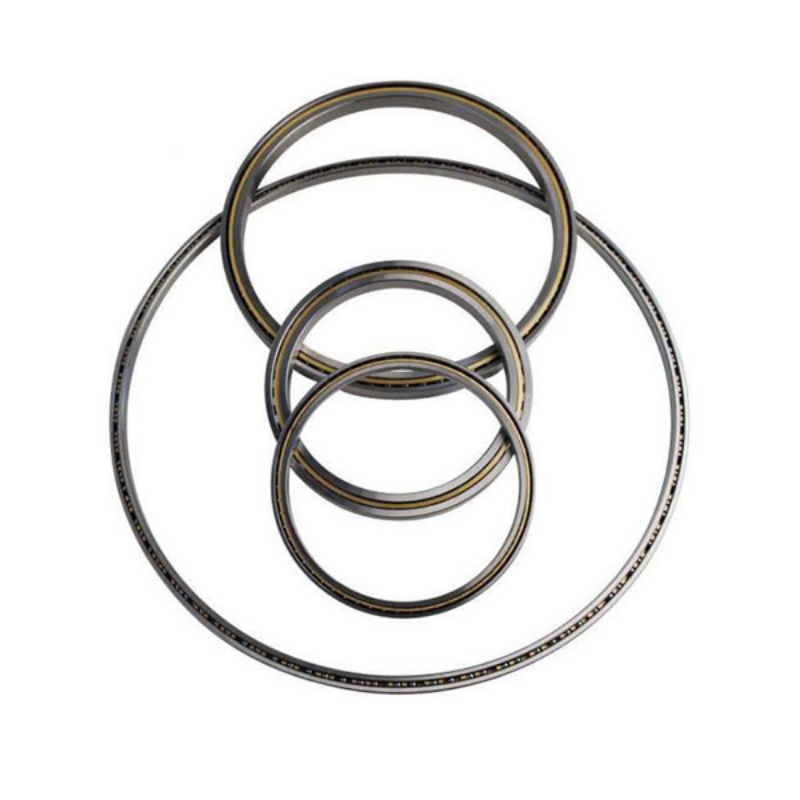
This family keeps identical cross-section dimensions across a broad bore range from 3/4 inch up to 40 inches,following ANSI/ABMA 26.2 specification.Famous product lines include Kaydon Reali-Slim,RBC and Silverthin equivalents.
Multiple fixed cross-section specifications (AA,G and others) are available.Even with enlarged bore diameter,wall thickness stays unchanged,which greatly simplifies gimbal,scanner and optical mechanism layout work.
|
Type-C,Type-A,Type-X:Select by Raceway Geometry
Within constant-cross-section thin-section bearings,three core raceway geometries serve different load cases.Always select according to real-world working loads instead of available stock items.
Type-C (Radial Contact) Similar geometry to standard deep-groove ball bearings.Delivers excellent radial-load performance,acceptable axial capacity and moderate overturning-moment resistance.Preferred option for radial-dominated operating conditions.
Type-A (Angular Contact) Outstanding single-direction axial-load capacity plus decent radial performance.Never deploy a single Type-A bearing alone under overturning moment or reversing axial load.It must be duplex-mounted:back-to-back,face-to-face or tandem configuration,just like standard angular-contact ball bearings.
Type-X (Four-Point Contact,Gothic-Arch Raceway) Unique gothic-arch raceway creates four contact points per ball.One single Type-X bearing can simultaneously withstand radial,bidirectional axial and overturning-moment loads.It often replaces two conventional bearings (duplex angular-contact set,thrust-plus-radial combinations) and brings ~50 % higher moment stiffness in many cases.
Trade-offs:higher friction torque and poorer pure-radial-load performance compared with Type-C.Avoid applying Type-X under purely radial-loading scenarios.
|
Note:C/A/X naming is widely-accepted industry convention originated from Kaydon/RBC/Silverthin,not ISO standard.Always cross-check against manufacturer datasheets.
Real-World Space & Weight Savings
Constant-cross-section thin-section bearings deliver the most dramatic space-weight reduction.Under identical shaft bore,thin-section bearings can cut envelope volume by 80 %-85 % and reduce weight by 80 %-83 % compared against standard-series bearings.
Calculation example for 50 mm bore:
6810 envelope volume:9 484 mm³
6010 envelope volume:49 009 mm³
6310 envelope volume:203 575 mm³
6810 reduces envelope volume by 80.6 % vs 6010,95.3 % vs 6310,while mounting on the same 50 mm shaft.
These benefits are only fully realised when you redesign shafts and housings around thin-section dimensions,instead of forcing thin-section bearings into legacy standard-bearing envelopes.Load is distributed across many smaller balls on an expanded pitch circle,maintaining acceptable contact stress under well-supported installation conditions.
You cannot directly compare basic dynamic load ratings across different thin-section bearing vendors.For one identical part number,published dynamic load figures may differ by over three-fold,and no supplier is deliberately falsifying data.
ISO 281 and ABMA Standard 9 load-rating formulas are built on critical assumptions which thin-section flexible rings violate:
Rigid,perfectly aligned supporting housing and shaft
Zero nominal internal clearance after mounting
Standard raceway curvature ratios
Constant-cross-section thin-section bearings,especially four-point Type-X models,are not fully covered by ISO 281 standard.Some suppliers directly look-up standard fc table values and output higher theoretical ratings;other manufacturers like Kaydon adopt real contact-stress calculation calibrated with long-term fatigue test data and publish more conservative figures.
Practical selection advice
Do not cross-compare load ratings coming from different manufacturers.Make comparisons only within one supplier’s technical system.
Ask suppliers which standard/calculation method generates their published load figures.
Complete L₁₀ service-life calculation based on real-application loads instead of only trusting catalogue load-rating values.
Tolerance:ABEC 1F to 7F for Constant-Cross-Section Bearings
Inch-size constant-cross-section thin-section bearings follow ANSI/ABMA 26.2 and use special ABEC 1F,3F,5F,7F tolerance grades.These differ from familiar ABEC 1-9 defined in ABMA Standard 20.
Large-diameter thin rings are flexible when unclamped.Free-state roundness readings on bare loose bearings do not reflect final operating geometry.The ring will conform to shaft and housing geometry once clamped in position.Real performance should be inspected after full mounting,not only on loose bearings at incoming-inspection stage.
Metric 68xx/69xx thin-size bearings still adopt conventional ISO 492 precision grades (P0,P6,P5,P4).
Installation Rules That Decide Bearing Service Life
Thin-section bearing rings deform following the geometry of mating shaft and housing seats.Final rotational accuracy,friction torque and fatigue life are heavily determined by housing and shaft machining quality,not bearing quality alone.
Seat Geometry Requirements
Housing/seat flatness shall match the axial run-out of the fitted ring.
Shaft bore roundness shall match the radial run-out of the fitted ring.
Pressing a thin outer ring into an out-of-round housing will deform the bearing raceway,create local binding,raise friction torque and trigger premature failure — even if the bearing itself is manufactured perfectly.
Configuration Rules by Bearing Type
Two Type-C bearings on a long shaft:arrange one bearing to float axially,absorbing thermal expansion from shaft-housing temperature difference and avoiding unintended axial preload.
Single Type-X fitted at one shaft end:the second supporting bearing on the opposite end should be Type-C with axial float.Avoid installing two Type-X bearings on the same shaft.
Type-A angular-contact bearings must work in duplex pairs (back-to-back/face-to-face).Do not stack multiple duplex sets without floating support at the far end.
Orientation Markings
Markings printed on thin-section bearings carry assembly instructions:
Snap-over cage radial/four-point bearings:install with solid cage surface upward,pocket opening downward for shaft inclination within 45° from vertical (follow “UP” arrow mark).Horizontal shafts have no preferred orientation.
Single Type-A carries “THRUST” marking plus arrow indicating allowable thrust direction.Duplex pairs align arrows opposite for back-to-back mounting;arrows point toward each other for face-to-face configuration.
Duplex matched sets feature “V” marks locating maximum radial run-out position.Align “V” marks to the minimum run-out zone of shaft/housing to minimise final assembled run-out.
Fits,Clamping and Lubrication
Published fit tables assume steel mating components,standard internal clearance and room-temperature environment.Mixed-material combinations change interference magnitude under temperature variation and may cause excessive radial preload during operation.
Face clamp plates with multiple small bolts tightened in star-pattern sequence deliver uniform clamping force;do not purely rely on press-fit to hold rings.If press-fit is mandatory,apply even force only onto the interference-fitted ring.Never transmit mounting force through balls and raceways.Use heating/cooling assembly for large interference and return components to ambient temperature before final torque tightening.
Important reminder:Open-type thin-section bearings are coated with anti-rust preservation oil only,not operational lubricant.Clean preservation oil completely before assembly and apply grease or oil matching your speed-load-temperature conditions.Sealed variants are factory-filled with general-purpose grease.
Application Scenarios & Alternatives
Select thin-section bearings when envelope dimension and weight are critical constraints under moderate load levels.Switch to standard heavy-series bearings if high load-capacity is your top priority.When moment load becomes extremely large at low rotating speed,consider slewing rings as alternative solution.
Robot joints and harmonic-reducer output supports
Medical CT/surgical robotic gimbal assemblies
Aerospace & defence opto-electronic gimbals,antenna positioning units
Semiconductor wafer-handling equipment
Optical measuring instruments,surveillance turntables
Cases where thin-section bearings are not recommended
Heavy radial load without rigid,precisely-machined supporting housing and shaft seats
High-speed operation with Type-X four-point-contact bearings (high friction generates excess heat)
Pure-radial-load conditions using Type-X design (choose Type-C instead)
Thin-section-bearing versus slewing-ring comparison
Choose slewing rings if you need integrated gear teeth,bolt-hole mounting pattern or extreme overturning-moment capacity at low rotational speed.Prefer thin-section bearings for medium-speed continuous rotation,low friction-torque requirements and when you can achieve high-quality roundness/flatness on mating seats.
Thin-section bearings demand more specification items than standard rolling bearings.Include these points in your inquiry to prevent repeated back-and-forth quotation rounds:
Bore size and cross-section family
Contact geometry (Type-C/A/X) plus duplex arrangement if required
Open,shielded or sealed configuration
Cage material and cage style
Precision grade (ABEC F-series for constant-cross-section;ISO P-grade for metric 68xx/69xx)
Internal clearance or preload requirements
Ring material (52100 chrome bearing steel/440C stainless steel) plus surface coating requirements
Lubricant specification or note “customer will lubricate on-site”
Calculation standard adopted for published static & dynamic load ratings
NewBee Transmission supplies metric 68xx/69xx thin-size bearings as well as constant-cross-section Type-C/A/X thin-section bearings ranging 10 mm-1000 mm bore,with open,shielded and sealed variants.Our engineering team supports custom dimension,material and pre-load optimisation for special-project requirements.
What defines a thin-section bearing?
A thin-section bearing has radial cross-section less than 1/4 of its bore diameter and less than twice ball diameter.It trades partial load-capacity and stricter mounting tolerance for compact envelope and light weight at unchanged shaft bore.
Are 6800/6900 series thin-section bearings?
Yes.They belong to metric ISO thin-size family.Their cross-section grows together with bore,so they cannot substitute constant-cross-section inch-size thin-section bearings directly.
What is the difference among Type-C,Type-A and Type-X thin-section bearings?
Type-C radial-contact works best under radial-dominated loads.Type-A angular-contact excels under single-direction axial loads and must be duplex-paired.Type-X four-point gothic-arch raceway handles combined radial-axial-moment loads,suitable for reversing moment conditions,yet performs poorly for pure-radial-load cases.
Why do load-rating figures differ across thin-section-bearing vendors?
ISO 281 original assumptions (rigid housing,zero-clearance mounting) do not apply for flexible thin rings.Some suppliers output theoretical table-lookup values;others deliver conservative test-calibrated results.Never compare ratings across different manufacturers.
Seat flatness should match ring axial run-out;shaft/housing bore roundness should match ring radial run-out.Thin rings copy the geometry of mating seats after clamping;poor seat quality creates early-stage bearing failure no matter how good the bearing itself is.
Final Key Takeaways
Thin-section definition is ratio-based (cross-section/bore < 0.25),not absolute thickness value.
Two distinct “thin-section” families exist:metric 68xx/69xx variable-cross-section,and inch-size constant-cross-section;they are non-interchangeable.
Match Type-C/A/X strictly to your real-world load combination.Type-X replaces two bearings for moment-loaded assemblies.
Always verify calculation methodology behind catalogue load-rating values;avoid cross-vendor rating comparison.
Constant-cross-section thin-section bearings use special ABEC 1F-7F tolerance grades,different from conventional ABEC standards.
Mounting-seat geometry largely determines final bearing performance;thin rings conform to shaft-housing shape after clamping.
For technical specifications,pricing,or custom bearing cage solutions:
Email:paul@newbeetrans.com
Website:www.newbeetrans.com




 WhatsApp
 sales@newbeetrans.com
 +8615090185276