
NewBee Machinery is a professional machinery parts manufacturer providing high quality precision bearings, high-quality non-standard transmission components, and intelligent CNC equipment and more.
NewBee Machinery is a professional machinery parts manufacturer providing high quality precision bearings, high-quality non-standard transmission components, and intelligent CNC equipment and more.
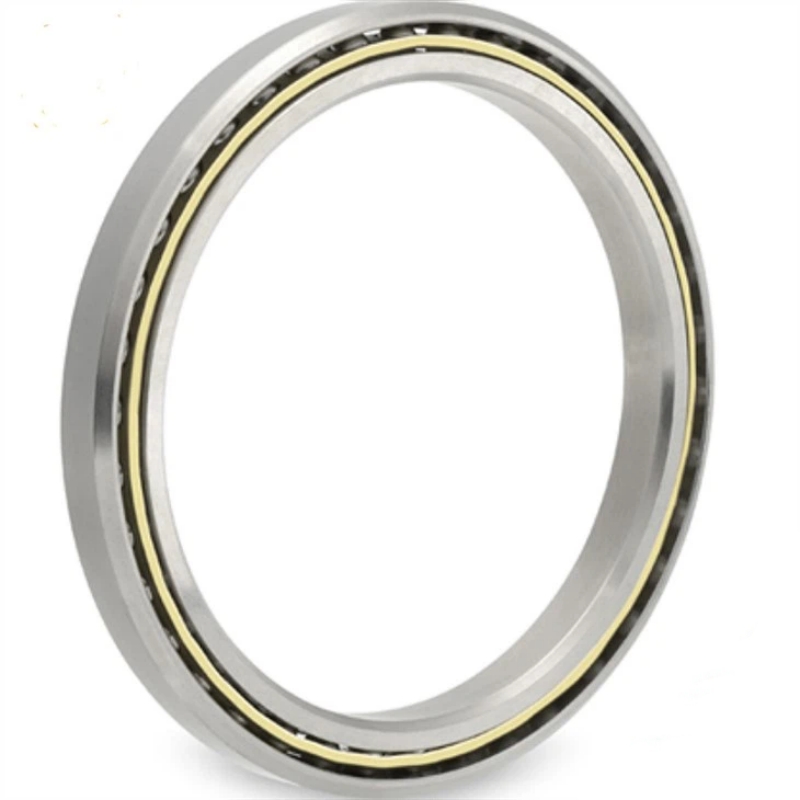
A bearing cage,also known as a bearing retainer or separator,is an important internal component of a rolling bearing.Its primary function is to separate and position the rolling elements,such as balls or rollers,at a controlled distance from each other.
Although the cage is not normally the main load-carrying component of a bearing,its design has a significant influence on bearing speed,friction,vibration,lubrication,temperature,and operating reliability.The correct cage material and structure are therefore essential when selecting a bearing for demanding applications.
A bearing cage is located between the inner ring,outer ring,and rolling elements of a bearing.It contains pockets or windows that accommodate individual balls or rollers and maintain their relative position during rotation.
As the bearing operates,the rolling elements continuously move along the raceways.The cage keeps them evenly spaced and guides their movement through the bearing.This prevents adjacent rolling elements from rubbing directly against each other and helps maintain stable rolling motion.
The cage is also sometimes called a bearing retainer or bearing separator.These terms generally refer to the same basic component.
The bearing cage performs several important functions:
1.Separates the Rolling Elements
The cage prevents balls or rollers from coming into direct contact with each other.This reduces unnecessary friction,sliding,and heat generation.
2.Maintains Even Spacing
The cage keeps the rolling elements distributed around the raceway.Proper spacing helps maintain smooth rotation and stable bearing operation.
3.Guides the Rolling Elements
During rotation,rolling elements pass through loaded and unloaded areas of the bearing.The cage helps control their movement and maintains the correct trajectory.
4.Supports Lubrication
Cage geometry influences the movement and distribution of grease or oil inside the bearing.Proper cage clearance and pocket design can help lubricant reach the rolling contacts.
5.Helps Maintain Bearing Assembly
For certain separable bearing designs,the cage can help retain the rolling elements and maintain the bearing assembly during handling and installation.
Cage design therefore affects more than simply the spacing between rolling elements.Cage material,pocket geometry,guidance method,and manufacturing accuracy can all influence bearing performance.
Bearing cages can be classified according to their manufacturing method,material,structure,and method of guidance.
Stamped Steel Cage
Stamped steel cages are formed from sheet steel through stamping and forming processes.They have a relatively simple structure,low weight,and good mechanical strength.
They are widely used in standard ball bearings and roller bearings and are suitable for many general industrial applications.
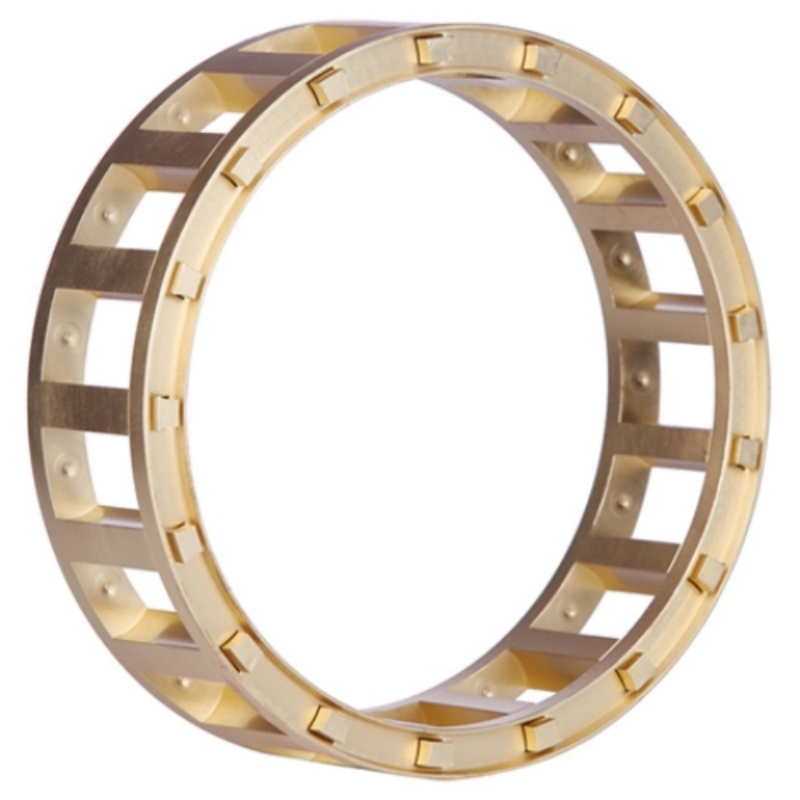
Machined Brass Cage
Machined brass cages are produced by precision machining from brass material.Compared with simple stamped cages,they provide greater flexibility in cage geometry and are commonly selected for demanding operating conditions.
Brass cages are frequently used in applications involving heavy loads,vibration,higher temperatures,or challenging lubrication conditions.
Machined Steel Cage
Machined steel cages are manufactured by turning,milling,drilling,and other precision machining processes.They are particularly suitable for larger bearings and applications requiring high structural rigidity or customized cage geometry.
Polyamide Cage
Polyamide cages,often reinforced with glass fiber,are lightweight and have relatively low inertia.Their low mass can be advantageous in high-speed bearing applications.
They can also provide good resistance to corrosion and suitable friction characteristics.However,polymer cage selection must consider operating temperature,lubricant compatibility,and long-term ageing.
Special Polymer Cage
For high-temperature,high-speed,or chemically demanding applications,advanced materials such as PEEK,phenolic resin,and other engineering polymers may be used.
The appropriate polymer depends on the complete operating environment rather than temperature alone.Material selection should consider the lubricant,chemical exposure,speed,load,and required service life.
The most common bearing cage materials include:
| Cage Material | Main Characteristics | Typical Applications |
| Stamped Steel | Strong, lightweight, economical | General industrial bearings |
| Machined Steel | High rigidity and design flexibility | Large and heavy-duty bearings |
| Brass | Good strength, wear resistance and temperature capability | Heavy-duty and industrial applications |
| Polyamide | Lightweight, low inertia and good high-speed capability | High-speed ball bearings |
| PEEK | High chemical and temperature resistance | High-performance and special bearings |
| Phenolic Resin | Lightweight and suitable for precision applications | Spindles and high-speed bearings |
In addition to material,the way a cage is guided is another important design factor.
A cage may be guided by the rolling elements or by a bearing ring,depending on the bearing design.Ring-guided cages can use the inner or outer ring as the guiding surface.
The guidance method influences friction,lubricant flow,cage stability,and behavior at high speed or during acceleration.
For this reason,two cages made from the same material may not perform identically if their guidance structures are different.
The manufacturing process depends on the cage material and design.
Stamped Cage Manufacturing
Typical production steps include:
Sheet material preparation
Stamping and forming
Pocket or window forming
Deburring
Cleaning
Dimensional inspection
Final quality inspection
This manufacturing method is particularly suitable for large-volume standard bearing production.
Machined Cage Manufacturing
Machined steel and brass cages normally require precision machining operations such as:
Turning
Milling
Drilling
Pocket machining
Chamfering
Deburring
Surface finishing
Dimensional inspection
Machining provides greater flexibility for special cage structures and customized bearing designs.
Injection-Molded Cage Manufacturing
Polyamide and other engineering plastic cages are commonly produced by injection molding.
The mold must accurately control the cage's pocket dimensions,wall thickness,geometry,and dimensional stability.Material formulation and molding conditions are also important for achieving consistent performance.
For advanced applications,specialized manufacturers can produce cages from materials such as PEEK,polyimide,and other high-performance polymers using precision machining or specialized manufacturing processes.
Bearing cages are used in a wide range of industries because most caged rolling bearings require a reliable method of controlling their rolling elements.
Automotive Bearings
Bearing cages are used in wheel bearings,transmissions,differentials,and other automotive systems.They must withstand changing speeds,vibration,temperature variations,and lubrication conditions.
Machine Tool Spindles
High-speed machine-tool spindles require bearings with controlled friction,low vibration,and high rotational accuracy.Lightweight polymer,phenolic,or specially designed cages may be used depending on the spindle design.
Electric Motors and Generators
Caged ball and roller bearings are widely used in electric motors and generators.Cage design contributes to smooth operation,low friction,and reliable long-term performance.
Gearboxes and Transmission Systems
Bearings inside industrial gearboxes operate under combined loads,variable speeds,and vibration.Steel,brass,and other cage designs can be selected according to the gearbox operating conditions.
Rolling Mills
Rolling mill bearings often operate under heavy loads,shock,vibration,and demanding lubrication conditions.Robust machined cages may be used in large roller bearing designs.
Pumps and Compressors
Cage material must be compatible with operating temperature,lubricant,speed,and sometimes special gases or chemicals.The correct cage design helps maintain stable rolling-element movement.
Robotics and Automation
Robotic joints and automation equipment often require compact,precise,and low-friction bearings.Lightweight cage designs can be advantageous where acceleration and repeated positioning are important.
Selecting a bearing cage requires more than simply choosing steel,brass,or plastic.The complete application should be evaluated.
Important factors include:
Bearing type and size
Rolling-element type
Radial and axial load
Rotational speed
Acceleration and deceleration
Operating temperature
Lubricant type
Lubricant quantity
Shock and vibration
Chemical exposure
Required service life
Installation conditions
Dimensional accuracy
For example,a lightweight polyamide cage may be suitable for a high-speed precision application,while a machined brass or steel cage may be more appropriate for heavy loads,shock loads,or demanding industrial environments.
NHBB also identifies rotational speed,starting and running torque,operating temperature,and noise requirements as important factors when selecting a cage.
Standard bearing cages are designed for commonly used bearing sizes and structures.They provide an economical solution for regular production and replacement applications.
However,some applications require a cage with special dimensions,materials,pocket geometry,guidance,or performance characteristics.
A custom bearing cage can be developed according to the requirements of the specific bearing and equipment.Customization may include:
Cage material
Cage dimensions
Pocket size and shape
Number of pockets
Wall thickness
Guidance method
Surface treatment
Special lubrication requirements
High-speed requirements
High-temperature requirements
Custom cage manufacturing is particularly useful for non-standard bearings,special machinery,precision equipment,and applications where standard cage designs cannot meet the required operating conditions.
Specialized bearing manufacturers can manufacture custom cages in steel,brass,engineering plastics,PEEK,phenolic resin,and other materials depending on the application.
Although a cage normally does not carry the primary bearing load,it can still be damaged during operation.
Common causes include:
Excessive rotational speed
Insufficient or unsuitable lubrication
Excessive acceleration
Severe vibration
Shock loading
Improper installation
Excessive internal clearance or abnormal operating conditions
Chemical attack from unsuitable lubricants or cleaning agents
Excessive operating temperature
Typical cage damage may include deformation,cracking,wear,pocket damage,corrosion,or fracture.
When cage damage occurs,it is important to investigate the operating conditions rather than simply replacing the cage.The underlying cause may involve lubrication,alignment,load,speed,installation,or material compatibility.
FAQ About Bearing Cages
What is a bearing cage?
A bearing cage is an internal bearing component that separates,spaces,and guides the rolling elements.It is also called a bearing retainer or separator.
What is the best material for a bearing cage?
There is no single best cage material for every application.Steel,brass,polyamide,PEEK,and other materials have different performance characteristics.Selection depends on speed,load,temperature,lubrication,chemical exposure,and service requirements.
Can a bearing work without a cage?
Yes.Some bearings are designed as full-complement bearings and contain more rolling elements without a conventional cage.However,removing a cage from a bearing that was designed to use one is not a simple performance upgrade.Cage and full-complement designs have different operating characteristics and speed capabilities.
Are bearing cages customizable?
Yes.Depending on the bearing manufacturer and application,cage material,dimensions,pocket geometry,guidance method,and other design features can be customized.
Does the bearing cage affect speed?
Yes.Cage mass,material,guidance,geometry,lubrication,and operating conditions can influence the bearing's allowable speed and dynamic behavior.Therefore,cage selection is particularly important for high-speed applications.
Conclusion
The bearing cage is a small but critical component that helps control the movement of rolling elements inside a bearing.By maintaining separation,spacing,and guidance,the cage contributes to smooth rotation,controlled friction,effective lubrication,and reliable bearing operation.
Steel,brass,polyamide,PEEK,phenolic resin,and other materials can be used for different bearing applications.The appropriate choice depends on the bearing structure and actual operating conditions.
For standard applications,a standard cage can provide an economical and reliable solution.For specialized machinery,high-speed equipment,heavy-duty systems,or unusual environmental conditions,a custom bearing cage may provide a better technical solution.
For technical specifications,pricing,or custom bearing cage solutions:
Email:paul@newbeetrans.com
Website:www.newbeetrans.com
 WhatsApp
 sales@newbeetrans.com
 +8615090185276