
NewBee Machinery is a professional machinery parts manufacturer providing high quality precision bearings, high-quality non-standard transmission components, and intelligent CNC equipment and more.
NewBee Machinery is a professional machinery parts manufacturer providing high quality precision bearings, high-quality non-standard transmission components, and intelligent CNC equipment and more.
Bearings are essential mechanical components used to support loads,guide movement,reduce friction,and control the relative motion between machine parts.Although rolling bearings are the most familiar type,the bearing industry includes a much broader range of designs based on different operating principles,load conditions,materials,and motion requirements.
Depending on the application,a bearing may use rolling contact,sliding contact,magnetic forces,or a fluid film to support movement.Understanding these differences is important when selecting the right bearing for industrial machinery,automation systems,transportation equipment,precision instruments,and other mechanical applications.
This guide introduces 11 major types of bearings,explaining their basic working principles,characteristics,and typical applications.
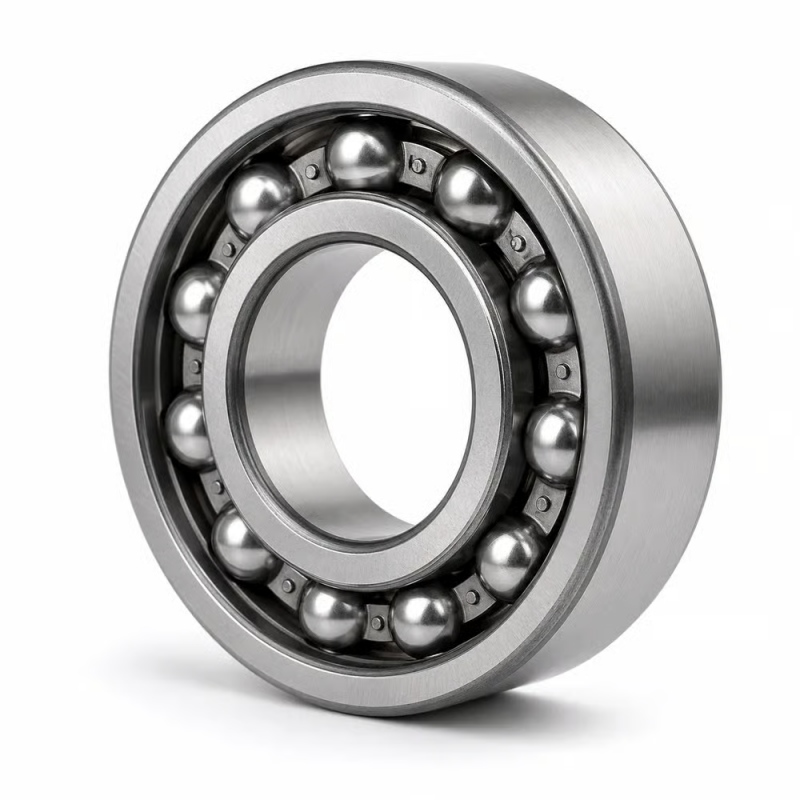
Ball bearings use spherical balls as rolling elements between an inner ring and an outer ring.When the bearing rotates,the balls roll along precision-machined raceways,reducing friction and transferring loads between the shaft and housing.
Because the contact area between a ball and raceway is relatively small,ball bearings generally provide low friction and good speed capability.They are commonly selected for applications where moderate loads,high rotational speed,and compact dimensions are important.
Common designs include deep groove ball bearings,angular contact ball bearings,self-aligning ball bearings,thrust ball bearings,and thin section ball bearings.
Typical applications include electric motors,pumps,fans,gearboxes,machine tools,robotics,household appliances,and precision equipment.
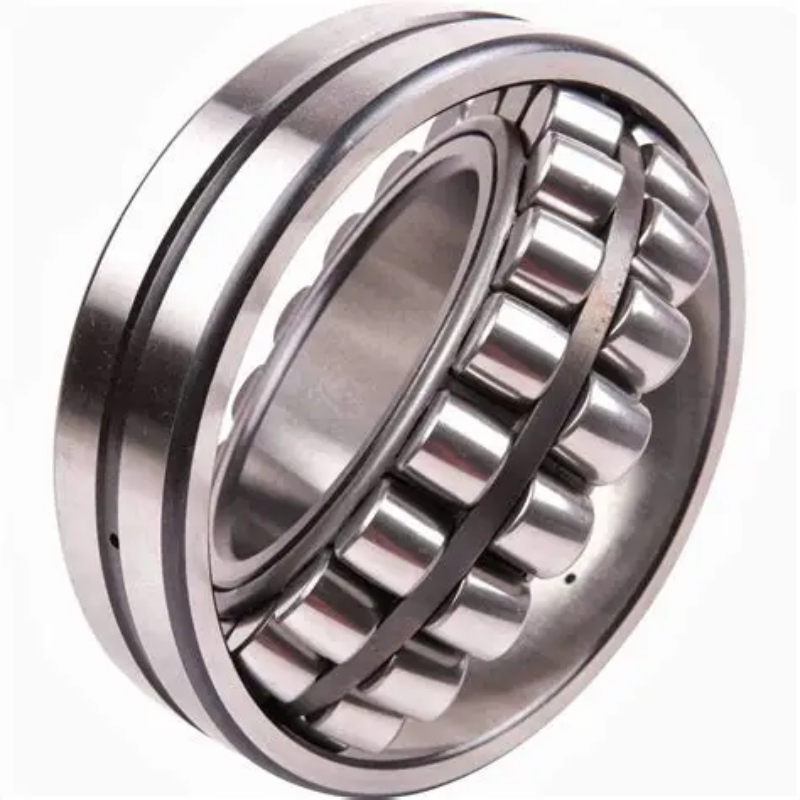
Roller bearings use cylindrical,tapered,spherical,or needle-shaped rollers instead of balls.
The main difference is the contact geometry.Rollers generally create line contact with the raceways,providing a larger contact area than ball bearings.This makes many roller bearing designs suitable for higher radial loads and applications requiring greater rigidity.
Major types include:
Cylindrical roller bearings
Tapered roller bearings
Spherical roller bearings
Needle roller bearings
Toroidal roller bearings
Cylindrical roller bearings are widely used for high radial loads,while tapered roller bearings can accommodate combined radial and axial loads.Spherical roller bearings are particularly useful where heavy loads and shaft misalignment must be accommodated.
Typical applications include rolling mills,industrial gearboxes,mining equipment,railway systems,automotive transmissions,and heavy machinery.
Unlike conventional rotary bearings,linear bearings are designed to guide components along a straight path.
Ball-type linear bearings use recirculating balls that roll between the moving component and guide shaft or rail.This rolling motion provides low friction and allows accurate linear movement.
Plain linear bearings are another option and use sliding contact rather than rolling elements.
Linear bearings are widely used in CNC machines,automation equipment,3D printers,semiconductor manufacturing systems,packaging machinery,laboratory equipment,and precision positioning systems.
When selecting a linear bearing,engineers need to consider stroke length,load,speed,positioning accuracy,rigidity,and moment loading.
Plain bearings,also called sleeve bearings or journal bearings,do not contain rolling elements.Instead,the shaft slides directly against a bearing surface or bushing.
In many designs,a lubricant separates the moving surfaces and reduces friction and wear.Depending on the operating principle,plain bearings can use hydrodynamic,hydrostatic,or boundary lubrication.
Plain bearings are mechanically simple,compact,and quiet.They can also be suitable for very high loads when correctly designed and lubricated.
Common materials include bronze,sintered bronze,Babbitt alloys,PTFE-based composites,and engineering polymers.
Typical applications include engines,turbines,pumps,compressors,industrial machinery,hinges,and other mechanisms where a simple and compact bearing arrangement is preferred.
Thrust bearings are designed primarily to support axial loads,meaning forces acting parallel to the shaft axis.
Unlike the classification of ball and roller bearings,“thrust” describes the primary direction of the load rather than the rolling element itself.Thrust bearings can therefore use balls,rollers,or sliding surfaces.
Common types include thrust ball bearings,cylindrical roller thrust bearings,tapered roller thrust bearings,and spherical roller thrust bearings.
They are used when axial forces are significant,such as in gearboxes,automotive systems,pumps,compressors,machine tools,marine equipment,and heavy industrial machinery.
The appropriate thrust bearing depends on axial load,speed,required rigidity,lubrication,and the ability of the surrounding structure to control radial movement.
Spherical plain bearings,sometimes called joint bearings,are designed primarily for oscillating movement and angular misalignment.
A typical spherical plain bearing consists of an inner ring with a spherical outer surface and an outer ring with a matching spherical internal surface.The inner ring can tilt relative to the outer ring,allowing the bearing to compensate for angular movement and certain alignment errors.
Unlike rolling bearings,spherical plain bearings operate through sliding contact.
They are particularly suitable for applications involving relatively slow oscillation rather than continuous high-speed rotation.
Typical applications include hydraulic cylinder rod ends,construction machinery linkages,aircraft control mechanisms,suspension systems,and articulated mechanical joints.
Standard bearing steels are suitable for a wide range of industrial applications,but some environments require alternative materials.
Specialty material bearings may use stainless steel,ceramics,engineered polymers,or hybrid combinations of different materials.
Ceramic rolling elements,for example,can provide advantages in certain high-speed,electrically sensitive,or demanding environments.Polymer and composite bearings may be selected where corrosion resistance,low weight,chemical resistance,or self-lubrication is important.
These bearings are commonly considered for semiconductor equipment,medical devices,chemical machinery,food-processing equipment,high-speed electric motors,aerospace systems,and other specialized applications.
Material selection should always be based on temperature,load,speed,corrosion exposure,lubrication,electrical conditions,and required service life.
Magnetic bearings support a rotating shaft using magnetic forces rather than conventional mechanical contact.
Because the shaft can be suspended without direct contact between the primary bearing surfaces,magnetic bearing systems can achieve extremely low mechanical friction and eliminate conventional rolling contact.
Active magnetic bearings use sensors,electromagnetic actuators,and control systems to maintain the shaft position dynamically.
This technology is particularly valuable in applications requiring very high rotational speed,low contamination,or minimal mechanical wear.
Typical applications include high-speed turbomachinery,compressors,vacuum equipment,energy systems,and specialized industrial rotating equipment.
The main consideration is that magnetic bearings require sophisticated control electronics and an appropriate backup system,making them more complex than conventional rolling bearings.
Fluid film bearings support a moving shaft through a thin layer of pressurized fluid rather than direct solid-to-solid contact.
In a hydrodynamic bearing,shaft rotation creates a wedge-shaped fluid film that generates pressure and separates the shaft from the bearing surface.Hydrostatic bearings,by contrast,use an externally supplied pressurized fluid to maintain separation.
When a stable fluid film is established,friction and wear can be very low.
Fluid film bearings are particularly suitable for large rotating machines and continuous-duty applications.
Typical applications include large turbines,compressors,generators,marine propulsion systems,industrial pumps,and heavy-duty rotating machinery.
The design of the lubrication system is critical.Fluid viscosity,temperature,pressure,shaft speed,clearance,and operating load all influence bearing performance.
Jewel bearings are specialized precision bearings made from extremely hard materials such as synthetic ruby or sapphire.
Instead of being designed primarily for heavy load capacity,jewel bearings are intended for very small loads and highly precise mechanisms.Their hard,smooth surfaces provide stable friction characteristics and excellent dimensional stability.
They are commonly found in mechanical watches,precision measuring instruments,meters,scientific equipment,and other miniature mechanisms.
The major advantage of jewel bearings is their ability to provide reliable,low-friction support for very small rotating components.
Because their load capacity is limited,they are not intended to replace conventional industrial rolling bearings in heavy machinery.
Mounted bearings,also known as bearing units,combine a bearing with a housing.
Instead of installing a separate bearing into a precision-machined housing bore,the complete unit can be attached directly to the machine structure.
Common configurations include:
Pillow block units
Flange-mounted bearings
Square flange units
Diamond flange units
Take-up bearing units
Mounted bearings are particularly convenient for machinery where simple installation,alignment,replacement,and maintenance are important.
They are widely used in conveyors,agricultural machinery,food-processing equipment,material-handling systems,fans,packaging machinery,and general industrial equipment.
The bearing inside the housing may be a deep groove ball bearing,self-aligning bearing,or another suitable rolling bearing depending on the design.
Choosing the correct bearing requires more than checking the shaft diameter and housing dimensions.
Engineers should first identify the type and magnitude of the load.Is the application primarily radial,axial,or a combination of both? Are there shock loads,vibration,or moment loads?
Next,consider operating speed.Ball bearings are often suitable for high-speed applications,while different roller bearing designs may be preferred when load capacity and rigidity are more important.
The operating environment must also be evaluated.Dust,water,chemicals,high temperatures,electrical currents,and limited lubrication can all influence bearing selection.
Other important factors include:
Bearing load capacity
Required service life
Internal clearance
Preload
Operating temperature
Lubrication method
Sealing requirements
Shaft and housing fit
Misalignment
Installation space
Required precision and stiffness
For example,a high-speed CNC spindle may require a precision angular contact ball bearing,while a heavily loaded conveyor may require a spherical roller bearing.A robotic joint with limited installation space may benefit from a thin section or crossed roller bearing,while a simple conveyor shaft may use a mounted bearing unit.
The best bearing is therefore not simply the largest or strongest bearing.It is the bearing whose design characteristics match the actual operating requirements of the machine.
The bearing industry includes far more than conventional ball and roller bearings.
The 11 major bearing categories-ball bearings,roller bearings,linear bearings,plain bearings,thrust bearings,spherical plain bearings,specialty material bearings,magnetic bearings,fluid film bearings,jewel bearings,and mounted bearings-represent different approaches to controlling motion,friction,and mechanical loads.
Each category has its own operating principle and advantages.Rolling bearings are widely used for efficient rotary motion,plain and fluid film bearings can provide solutions for heavy continuous-duty machinery,linear bearings guide precise straight-line movement,spherical plain bearings accommodate oscillation and misalignment,while magnetic and specialty-material bearings address demanding high-speed or specialized environments.
For technical specifications,pricing,or custom bearing cage solutions:
Email:paul@newbeetrans.com
Website:www.newbeetrans.com
 WhatsApp
 sales@newbeetrans.com
 +8615090185276