
NewBee Machinery is a professional machinery parts manufacturer providing high quality precision bearings, high-quality non-standard transmission components, and intelligent CNC equipment and more.
NewBee Machinery is a professional machinery parts manufacturer providing high quality precision bearings, high-quality non-standard transmission components, and intelligent CNC equipment and more.
Thrust bearings are specially designed to withstand axial loads acting parallel to shaft centre-lines.From marine propeller shafts and turbine rotors to automotive crankshaft assemblies,any rotating shaft generating axial thrust requires corresponding thrust support.The global thrust-bearing market reached USD 3.98 billion in 2026,driven by EV powertrain expansion,offshore wind installation and industrial automation growth.
Thrust bearing is an umbrella term covering six distinct construction variants,each with unique speed,load-carrying and misalignment-handling performance.Wrong selection will degrade equipment performance and even trigger catastrophic component failure.This engineering guide compares all six mainstream thrust-bearing solutions with practical engineering data and delivers step-by-step selection workflows for real-world operating conditions.
Thrust bearings are defined as bearings primarily intended for axial-load support with contact angles between 45° and 90°.Bearings with contact angles below 45° are classified as radial bearings,whose primary duty is forces perpendicular to shaft axis.
Thrust bearings fall into two fundamental working categories:
Rolling-element thrust bearings:Balls or rollers roll between hardened raceway washers.They feature compact dimensions,support grease lubrication and facilitate on-site replacement,and are suited for medium-speed operating scenarios.
Fluid-film thrust bearings (tilting-pad):A converging hydrodynamic oil wedge forms between pivoted pads and rotating thrust collar,without any rolling elements.This family serves extreme-speed and heavy-load turbomachinery,running with circulating oil lubrication and real-time temperature monitoring.
NewBee Transmission product note NewBee Transmission supplies full-range thrust ball bearings (51100-51400 series) and spherical roller thrust bearings (29200-29400 series) with bore sizes covering 10 mm-1250 mm.In field practice,insufficient pre-load causing roller skidding accounts for most premature failures,especially for vertical-shaft pump applications.
All rolling-element thrust bearings demand sustained minimum axial applied load.Insufficient axial load will make rolling-elements slide instead of roll over raceway surfaces and produce accelerated surface wear.As NTN product documentation states:adequate axial pre-load must be applied to avoid sliding contact between rolling elements and raceways.
If you are uncertain whether your application generates meaningful axial thrust,re-evaluate system requirements — sometimes radial-type bearings or plain bushings represent more cost-effective alternatives.
Six Major Categories of Thrust Bearings
Five rolling-element configurations plus one fluid-film tilting-pad type cover most industrial use-cases.Each design realises different trade-offs among load-capacity,maximum speed,self-aligning performance and physical dimension.
| Type | Load Capacity | Max Speed | Self-Aligning | Typical Application |
| Thrust ball bearing (51xxx series) | Low-Medium | High | No | Clutches, fans, pumps |
| Cylindrical roller thrust bearing (811/812/893 series) | High | Low-Medium | No | Machine tools, extruders |
| Needle roller thrust bearing (AXK/NTA series) | Medium | Medium | No | Compact-layout transmissions |
| Tapered roller thrust bearing (TTHD/TTHDFL series) | Very High | Medium | No | Mill screw-down assemblies, crane hooks |
| Spherical roller thrust bearing (292/293/294 series) | Highest | Low-Medium | Yes (1°-2°) | Marine equipment, heavy-duty machinery |
| Tilting-pad (fluid-film) | Very High | Extreme (160 m/s) | Yes (pad pivoting) | Steam turbines, generators |
Thrust ball bearings (51100-51400 series)
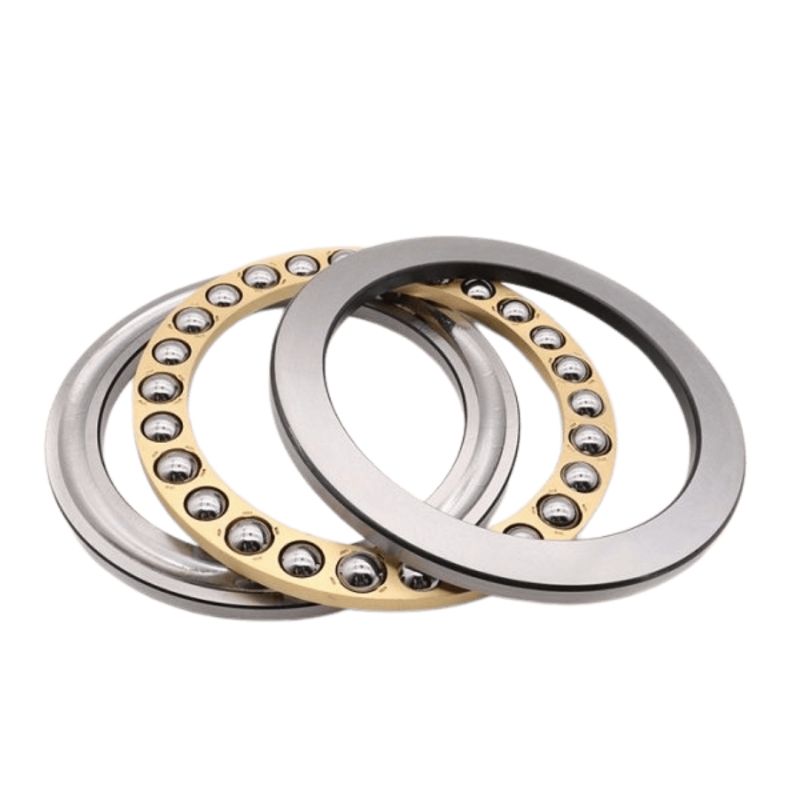
Designed for relatively light axial loads.Spherical balls operate at a 90-degree contact angle between two hardened washers.Advantages include low cost,compact footprint and high permissible speed.Limitation:cannot sustain heavy axial loads or significant radial loads.
Cylindrical roller thrust bearings (811/812/893 series)
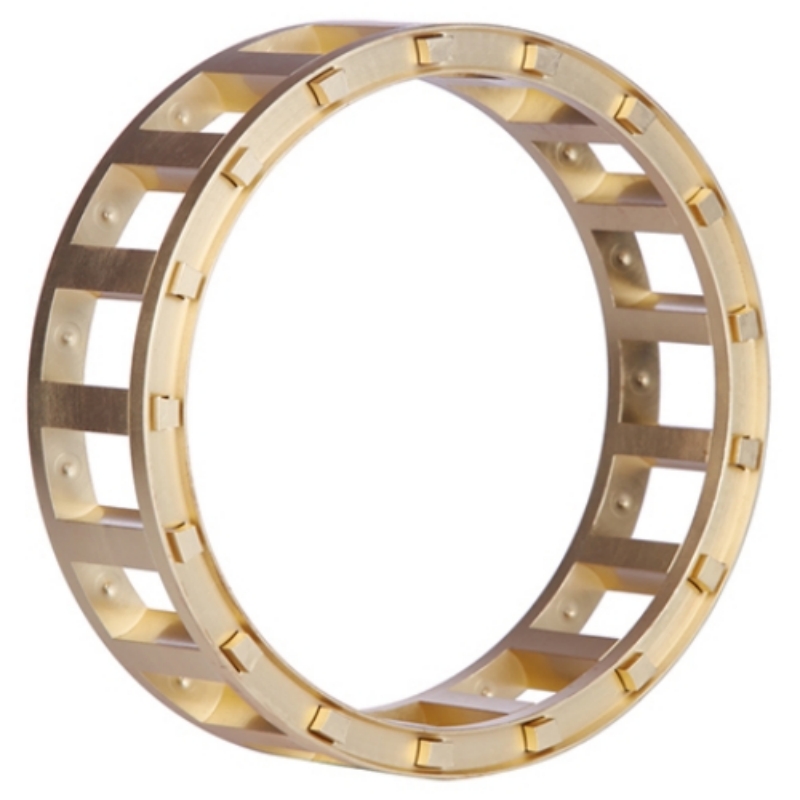
Replace balls with short cylindrical rollers to achieve greatly improved load-capacity and axial stiffness,at the price of higher friction and reduced limiting speed.NewBee manufactures this series with precision machined brass cages for demanding industrial environments.
Needle roller thrust bearings
Optimised balance between load-capacity and space occupation.Slender needle rollers deliver substantial load-capacity within ultra-thin axial cross-sections,the preferred solution when axial installation space is severely restricted,widely deployed inside automotive transmissions and drive-shaft assemblies.
Tapered roller thrust bearings (TTHD/TTHDFL series)
Modified tapered rollers whose cone apexes converge to a common pivot point to realise pure rolling motion.Among rolling-element thrust bearings they deliver top-tier load-capacity within given envelope dimensions and tolerate limited radial load components.Max peripheral surface velocity reaches 25-30 m/s (Timken).
Spherical roller thrust bearings (29200-29400 series)
Engineered for heavy-load operating conditions.Barrel-shaped spherical rollers work with spherically contoured raceways,compensating shaft misalignment and shaft deflection up to 1°-2°.It can accept combined loads,yet radial component shall not exceed 55 % of axial load (Fr/Fa ≤0.55).Oil lubrication is mandatory even under low-speed conditions.
Tilting-pad thrust bearings (fluid-film type)
Completely different working principle without rolling-elements.Each pad tilts around its fulcrum and creates convergent hydrodynamic oil wedge against rotating thrust collar.It handles sliding speed up to 160 m/s and absorbs extreme thrust loads which rolling-element bearings cannot withstand.
Market statistics for 2025 show thrust ball bearings account for 38.5 % global revenue share of thrust-bearing market;thrust roller bearings account for 28.3 % (Dataintelo).This split reflects core engineering compromises:ball-type realises higher speed and lower friction with moderate load-capacity; roller-type delivers much higher load-rating with reduced speed ceiling and higher component complexity.
Select thrust ball bearings when:
Applied axial load falls within light-to-medium range
High rotational speed is required (fastest rolling-element thrust solution)
Compact,economical and easy-to-mount hardware is needed
Working scenarios:clutches,fans,centrifugal pumps,household appliances
Select thrust roller bearings when:
Heavy axial load exists (cylindrical roller thrust delivers 2-5 times higher capacity compared with equally-sized thrust ball bearings)
High axial rigidity is required (machine rotary tables,screw presses)
Limited axial space but considerable thrust load exists (needle-roller variants)
Combined axial-radial load occurs (tapered-roller thrust only)
Performance difference originates from contact geometry.Balls create point-contact against raceways (deforms into tiny ellipse under load).Rollers achieve line-contact and spread stress over much larger contact area,raising load-capacity while introducing differential sliding friction.
Market forecast indicates thrust-roller-bearing segment CAGR reaches 5.4 %,slightly above thrust-ball’s 5.0 %,fuelled by growing demand for heavy-duty industrial automation equipment.Though currently only 15 % market share,magnetic-levitation thrust bearings represent the fastest-growing segment at 6.2 % CAGR for aerospace and semiconductor zero-contact,oil-free operation requirements.
Quick practical rule-of-thumb:
If axial load <10 kN and speed >3000 rpm → start evaluation from cost-effective thrust ball bearings.
Higher thrust-load or higher axial-stiffness requirement → cylindrical / tapered roller thrust bearings.
Combined load plus shaft misalignment → spherical roller thrust bearing.
Surface sliding velocity >30 m/s → adopt tilting-pad fluid-film thrust bearing.
Large-size tilting-pad thrust bearings applied inside hydro-generators may reach 5 m outer diameter and dissipate friction loss up to 1 MW — beyond the survivable operating envelope for any rolling-element bearing (MDPI Lubricants,2015).That explains why steam turbines,gas turbines and large compressors rely on Kingsbury-style tilting-pad thrust bearings for axial-thrust absorption.
Each individual pad tilts on its pivot,building up convergent hydrodynamic oil wedge and maintaining complete metal-to-metal separation.Minimum oil-film thickness lies between 20-50 μm (thinner than human hair),permitting relative sliding velocity up to 40-45 m/s.
Per Miba catalogue data,well-designed tilting-pad units support sliding velocity 160 m/s with specific pressure 2.5 MPa using VG32 lubricant and offset pivots.Compare with Timken TTHD tapered-roller thrust bearing limit of merely 25-30 m/s; fluid-film design achieves around five-fold speed improvement.
Important note often overlooked in general-purpose articles:many resources only introduce rolling-element thrust bearings.For turbines,gas-turbine generators and large compressors,tilting-pad fluid-film bearings represent the only feasible hardware option.A single tilting-pad thrust bearing for a 500 MW steam turbine can cost USD 30 000-80 000 and withstand axial thrust above 2 MN.
Design calculation for tilting-pad bearings follows different criteria compared with rolling-element bearings.Engineers do not apply ISO 281 life calculation; instead they check minimum oil-film thickness (>20 μm target),maximum babbitt temperature (~121 °C alarm limit) and specific pressure (typical range 2-4 MPa).Industry best-practice suggests installing temperature sensors at approximately 75 % pad arc length,setting alarm temperature at 110 °C and trip temperature threshold at 121 °C.
A noteworthy research observation from MDPI papers:above 40 m/s sliding speed,more than 30 % total power loss originates from oil churning and mixing losses outside the load-carrying oil-wedge.This drives adoption of directed-lubrication designs injecting oil precisely onto pad leading-edge rather than flooding the whole bearing housing.
Asia-Pacific contributed 42.8 % of global thrust-bearing revenue in 2025 (~USD 1 billion),powered by China’s huge automotive manufacturing capacity including 39 % EV production share (Dataintelo).Thrust-bearing deployment covers far wider scope than only automotive sectors.
Automotive & Electric Vehicles
Every internal-combustion crankshaft incorporates at least one thrust bearing controlling axial float,normally using flanged half-washers or dedicated thrust-washers.Additional thrust solutions exist inside transmissions:thrust needle-roller sets for planetary gear-sets and thrust ball bearings within clutch release assemblies.
Electric-vehicle applications create rising demand:high-speed traction motors rotating above 20 000 rpm require precision thrust bearings to counteract electromagnetic axial-thrust absent from traditional combustion powertrains.
Heavy-Duty Industry & Rolling Mills
Steel-plant screw-down mechanisms adopt TTHD / TTHDFL tapered roller thrust bearings to transmit massive rolling force onto work rolls,engineered for combined huge thrust load plus heavy shock-load conditions.Crane hooks,extruders,cone crushers and pulp refiners heavily utilise heavy-duty thrust-roller bearings.
NewBee Transmission field reference case:We supplied model 29340M spherical roller thrust bearings for vertical raw-material mill inside one cement plant.Previous cylindrical-roller thrust bearings failed every eight months caused by foundation-settlement-induced misalignment.Spherical-roller thrust bearing’s built-in 1.5° self-aligning capability eliminated this failure mode without mill-frame realignment modifications; bearings have run continuously more than 14 months.
Turbomachinery & Power Generation
Steam turbines,gas turbines,hydro-generators and large centrifugal compressors — any high-speed rotor generating considerable axial thrust — adopt tilting-pad fluid-film thrust bearings.Individual large hydro-generator thrust units support axial thrust as high as 2.25 MN (230 ton) running at 600 rpm.
Marine,Oil & Gas
Ship propeller shafts transfer enormous propulsive thrust to hull structures via dedicated thrust-bearing housings (Michell / Kingsbury-type configurations).Off-shore oil-gas equipment applies corrosion-resistant thrust-bearing hardware for well-head assemblies enduring extreme pressure and temperature cycles.
Per NTN engineering guidelines,thrust-bearing selection is governed by four key parameters:magnitude of axial load,working rotational speed (DN-value or peripheral velocity),misalignment tolerance and available installation space.For tilting-pad bearings typical design limits sit at 1.38 MPa unit-load and 91 m/s surface velocity (Texas A&M Turbomachinery Symposium).
Simplified step-by-step selection workflow:
Step 1:Define axial-load magnitude
Light load (< 10 kN):start evaluation from thrust ball bearing
Medium load (10-100 kN):cylindrical-roller or needle-roller thrust bearing - Heavy load (> 100 kN):tapered-roller or spherical-roller thrust bearing
Extreme-load plus high-speed (> 500 kN):tilting-pad fluid-film thrust bearing
Step 2:Verify rotational / surface speed
If peripheral velocity exceeds rolling-element practical ceiling (25-30 m/s),specify tilting-pad fluid-film bearing.
Within rolling-element portfolio:thrust-ball supports highest speed rating; cylindrical-roller thrust delivers lowest maximum speed.
Step 3:Evaluate misalignment risk
When shaft-deflection or housing-misalignment is anticipated:spherical-roller thrust bearing (1°-2° self-aligning capacity) or tilting-pad bearing with pivoting pads.
Perfectly-aligned predictable hardware:any thrust-bearing category is acceptable.
Step 4:Measure available installation space
Minimal axial envelope:needle-roller thrust bearing (thinnest cross-section).
Sufficient footprint:choose according to load-speed optimisation.
Step 5:Check combined-load situation
Pure-axial load:ball / cylindrical-roller / needle-roller thrust.
Combined axial-radial load (Fr/Fa ≤ 0.55):tapered-roller or spherical-roller thrust bearing.
High-speed mixed-load condition:matched-set angular-contact ball bearings sometimes represent better alternative than standalone thrust-bearing hardware.
Important frequently-missed factor:lubrication compatibility.Rolling-element thrust bearings accept grease-lubrication or circulating-oil-lubrication.Spherical-roller thrust bearings require forced oil-lubrication even under low-speed conditions per NTN specifications.Tilting-pad bearings demand complete circulating-oil loop plus external cooling infrastructure.
For rolling-element thrust-bearing fatigue-life calculation,please refer to ISO 281 standard documentation.
Root Causes of Thrust-Bearing Failures
For babbitt-lined tilting-pad pads,material softening and smearing will occur around 121-135 °C.Rolling-element thrust-bearing failure mechanisms follow different physical principles but remain predictable.
Failures of Rolling-Element Thrust Bearings
Fatigue spalling:Occurs after reaching calculated design service-life.ISO 281 defines L₁₀ rating-life:statistical number of revolutions when 10 % identical bearings will develop rolling-contact spalling.It represents material-fatigue phenomenon instead of manufacturing defect.Over-loading or contaminating environment greatly accelerates spalling onset.
Insufficient minimum axial pre-load:Creates roller / ball skidding,rolling-elements slide rather than roll,generating local hot-spots and surface damage.Very common for vertical-shaft applications where gravity cannot guarantee adequate sustained thrust pre-load.All rolling-element thrust bearings need continuous minimum axial load.
Poor lubrication:Incorrect grease viscosity,insufficient feed-rate or contamination are major contributors to premature breakdown.Spherical-roller thrust bearings cannot work reliably on grease alone; oil-circulation lubrication is mandatory.
Thermal runaway:Oil-film thickness falls below safe threshold (~20 μm).Friction raises component temperature,oil viscosity drops,further thinning oil-film thickness,creating positive-feedback loop ending with babbitt smearing.Temperature monitoring is mandatory; recommended alarm 110 °C,trip threshold 121 °C.
Loss of oil supply:Once lube-oil pump trips,metal-on-metal contact happens within seconds.Critical turbomachinery is therefore fitted with emergency DC oil-pumps plus accumulator backup.
Misalignment damage:Non-self-aligning pad-design concentrates load onto pad edges under misalignment.Dual temperature-sensors per-pad are recommended for detecting asymmetric thermal signature before permanent damage arises.
Preventing thrust-bearing failures starts at design-phase:select correct bearing-type,validate L₁₀ life or oil-film thickness calculation,specify proper lubrication setup,and fit temperature-monitoring hardware for mission-critical equipment.
Global thrust-bearing market size reached USD 3.98 billion in 2026 versus USD 3.72 billion for 2025 (7 % YoY growth).Forecast projects USD 5.25 billion market volume by 2030 with 7.2 % compound annual growth rate (Research and Markets).
Three major growth drivers:
Electric-vehicle manufacturing:EV traction-motors operate at 15 000-20 000+ rpm,far exceeding traditional combustion-engine transmission speed,demanding higher-precision thrust-bearings to manage electromagnetic axial-thrust.
Off-shore wind-power deployment:Wind-turbine gear-sets require heavy-duty spherical-roller thrust bearings handling above 500 kN thrust from blade pitch-control forces.
Industrial-automation expansion:Precision machine-tools,semiconductor production equipment and automated warehousing systems call for tighter dimensional tolerances and extended re-lubrication intervals.
Global competitive landscape is dominated by SKF,Timken,NSK,NTN,JTEKT (Koyo) and Schaeffler.Notable 2024 industry acquisition:China-based XCC Group acquired US-based WJB Automotive LLC,combining Chinese manufacturing scale with North-American market access and automotive application know-how.
FAQ
Q:What differentiates thrust bearings from radial bearings?
A:Thrust bearings sustain axial loads (forces parallel with shaft axis) with contact-angle 45°-90° (NTN).Radial bearings support loads perpendicular to shaft centre-line.Most rotating machines utilise both families:radial bearings carry shaft weight; thrust bearings constrain axial shaft-float.Certain variants (tapered-roller,angular-contact ball) accept mixed-load conditions.
Q:Journal plain bearing versus thrust bearing?
A:Journal bearings are radial plain bearings where shaft journal rotates inside cylindrical bushing.Thrust-bearings handle axial-direction forces.Turbomachinery frequently uses tilting-pad plain-bearings for both purposes but they support different load directions.
Q:Can thrust bearings accept radial loads?
A:Only specific constructions can do so.Tapered-roller thrust and spherical-roller thrust bearings tolerate combined loads with radial component limited ≤55 % of axial load (Fr/Fa ≤0.55 per NTN specification).Thrust-ball and cylindrical-roller thrust bearings are purely axial-load hardware; applying radial forces will immediately induce component damage.
Q:What service-life can thrust bearings achieve?
A:Rolling-element thrust bearings follow ISO 281 L₁₀ fatigue-life formula:life is inversely proportional to load-cubed (ball-type) or load^(10/3) (roller-type).Well-maintained tilting-pad fluid-film bearings can operate theoretically indefinitely if oil-film stays >20 μm and babbitt temperature remains below 85 °C,as no rolling-contact fatigue mechanism exists.
Q:What causes noise inside thrust bearings?
A:Insufficient minimum axial pre-load ranks as top-root-cause.Without sustained thrust-load rolling-elements rattle inside race-grooves and produce acoustic noise.Additional sources:particulate contamination inside lubricant,cage damage caused during handling,roller-skidding induced by inadequate pre-load.Low-frequency rumble noise usually indicates early-stage spalling,detectable by vibration-analysis prior to visible surface damage.
There is no universal one-size-fits-all thrust-bearing solution within this USD 3.98 billion-market.Different applications demand fundamentally-different construction designs:- Light axial-load & high-speed → Thrust ball bearing (51xxx series) - Heavy axial-load & high rigidity → Cylindrical roller thrust bearing (811/812 series) - Compact installation space with moderate thrust-load → Needle-roller thrust bearing (AXK/NTA) - Maximum load-capacity plus combined-load requirement → Tapered-roller thrust bearing (TTHD/TTHDFL) - Heavy-load together with shaft / housing misalignment → Spherical roller thrust bearing (292/293/294 series) - Extreme peripheral-speed (>30 m/s) → Tilting-pad fluid-film thrust bearing (Kingsbury / Miba-style)
Core selection principle remains unchanged:match bearing-type to axial-load magnitude,rotational-speed,misalignment-risk and available mounting space.Market-demand evolves simultaneously towards lightweight high-speed for EV powertrains and heavy-duty high-load for offshore-wind-power and industrial-automation.
For technical specifications,pricing,or custom bearing cage solutions:
Email:paul@newbeetrans.com
Website:www.newbeetrans.com

 WhatsApp
 sales@newbeetrans.com
 +8615090185276